Smallmouth Secrets: How to Target the Hardest Fighting Fish in the Stream

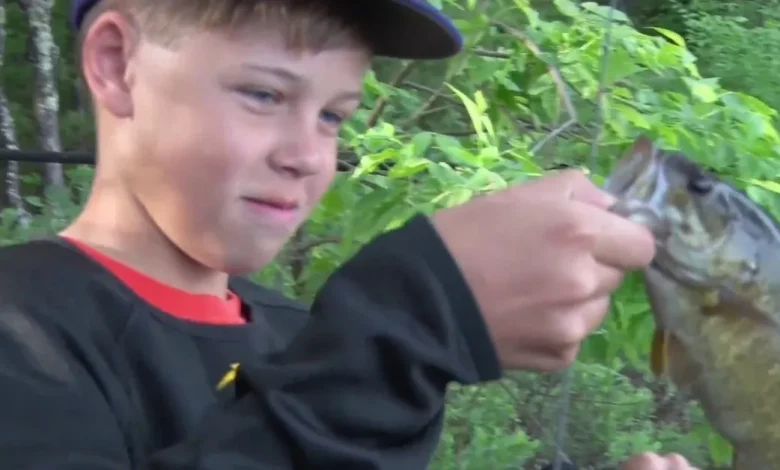
The Fish That Rewrites Your Expectations
There’s a moment every angler remembers. Not the biggest catch, not the most fish landed but the first time a smallmouth bass took the lure and the rod nearly left their hand. It’s a violence that feels disproportionate to the fish’s size, a raw, torquing energy that seems to come from somewhere deeper than muscle. Smallmouth bass don’t just fight. They negotiate the terms of the fight, and they rarely accept yours.
Rivers hold a different kind of smallmouth than lakes do. Current-conditioned fish are leaner, faster, and meaner in a way that’s almost philosophical they’ve spent their lives reading water, resisting flow, ambushing prey in a world that never holds still. That’s the fish we’re talking about here. The stream smallmouth. The one that will make you rethink every assumption you brought to the water.
Reading the River Like the Bass Does
Most anglers look at a river and see water. Smallmouth look at it and see a three-dimensional chess board, and if you want to find them consistently, you need to start thinking in their terms.
Current is the organizing principle of everything. Smallmouth are ambush predators who also need to conserve energy, which means they’re almost always positioned at the edge of something the seam between fast and slow water, the downstream shadow of a boulder, the soft pocket behind a fallen tree. They want the hydraulic advantage: a place where they can hold without burning calories, yet launch forward the instant something edible drifts past.
Learn to identify transition zones. Where gravel beds give way to sand, where a riffle drops into a deeper pool, where shade cuts across current these are the structural edges that concentrate fish. A pool that looks featureless from the bank often has a subtle depression in the middle, a slight temperature differential, a submerged ledge invisible until you wade it. The angler who takes twenty minutes to study a stretch before ever making a cast will almost always outfish the one who starts blind.
Water temperature matters more than most people realize. Smallmouth are cold-blooded creatures whose metabolism is entirely governed by thermal conditions. Between 65°F and 72°F, they are at their most aggressive and most active. Below 55°F, they become sluggish and lock tight to bottom structure. Above 80°F, they move to oxygenated riffles or seek spring-fed seeps. Carry a thermometer. It’s not optional it’s a map.
Lure Selection and the Logic of Presentation
The smallmouth bass has been romanticized into a creature of mythic selectivity, but the truth is more nuanced. They’re opportunistic, not picky but they are acutely sensitive to presentation. The same fish that ignores a dozen casts will crush a lure on the thirteenth if the angle changes, the retrieve slows, or the bait ticks the bottom at a slightly different depth.
Tubes are perhaps the most underrated weapon in the stream angler’s arsenal. A 3.5-inch tube jig in green pumpkin or watermelon red, rigged on a 3/16 to 3/8 oz head depending on current speed, can be worked along the bottom in a way that mimics crayfish with uncanny accuracy. Smallmouth eat crayfish the way people eat chips compulsively, without much deliberation. The key is keeping contact with the bottom. If you’re not occasionally snagging, you’re probably fishing too high.
Ned rigs have earned their reputation for a reason. The buoyancy of the ElaZtech plastic combined with a light mushroom head creates a presentation that stands tail-up on the bottom, quivering in current, looking absolutely helpless. In pressured water rivers near cities, popular wade-fishing stretches the Ned rig often outperforms everything else because it asks nothing of the fish. It just sits there, looking easy.
For covering water and triggering reaction strikes, nothing beats a well-worked swimbait or a bladed jig. Moving through current seams with a 2.8-inch paddle tail on a 1/4 oz swimbait head, varying the retrieve cadence, letting it pendulum down through the water column at the end of a swing this is how you find active fish and make them commit. Topwater in low-light conditions deserves its own mention. A walking bait worked across a flat just before dark on a summer evening, with the river going quiet around you, is one of the genuinely transcendent experiences available to a freshwater angler.
Wading Tactics and the Art of Approaching Without Spooking
Stream smallmouth are wary in ways that lake fish simply aren’t. Sound travels through water four times faster than through air, and every careless footstep on gravel sends a pressure wave that a fish forty feet away can feel through its lateral line. You are announcing yourself constantly the question is whether you’re doing it loudly or quietly.
Wade upstream whenever possible. Fish face into current, which means their eyes and lateral lines are oriented forward. Approaching from behind gives you an enormous positional advantage. Move slowly, deliberately, placing each foot before shifting weight. Polarized glasses aren’t just for spotting fish they let you read the bottom and avoid the stumbles that send shockwaves through a pool you’ve spent ten minutes approaching.
Cast angles matter as much as lure choice. A cast quartered upstream, allowed to swing naturally through a seam, often produces strikes that a straight downstream cast never would. The lure behaves differently it accelerates and decelerates with the current, it turns in the flow, it does things that look alive because they’re dictated by physics rather than retrieve. Let the river work for you.
The Fight, and What It Demands of You
When a river smallmouth takes your lure and runs, the instinct is to muscle it. Resist that instinct completely. Smallmouth jump sometimes three, four times in a single fight and a tight line during an aerial run is how you lose fish. The moment you see it clear the surface, bow to the fish: drop your rod tip, give slack, let the jump happen without tension. It feels wrong every time. Do it anyway.
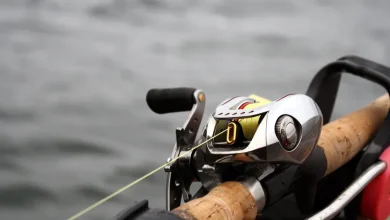
Medium-light to medium power spinning tackle in the 7-foot range gives you the sensitivity to feel bottom contact and the backbone to steer fish away from structure. Fluorocarbon in 8 to 12 pound test is the standard for a reason it’s nearly invisible underwater, has low stretch for better feel, and handles the abrasion of rocky environments better than monofilament. Braid-to-fluorocarbon setups have their advocates, particularly for long-distance sensitivity, but in clear streams, a straight fluoro leader is often the less conspicuous choice.
Play the fish, but play it efficiently. Prolonged fights in warm water exhaust smallmouth to a degree that can be genuinely harmful. Get them to hand, keep them wet, support the body horizontally if you’re holding them for a photo, and watch them swim away under their own power before you move on. The fish you release well today is the fish someone else gets to fight tomorrow and the fish you might meet again yourself, an inch longer, a season wiser.
What the River Keeps Teaching
There’s something about stream fishing for smallmouth that resists the kind of mastery that makes you stop paying attention. The river changes every season, every rain event, every temperature swing. A pool that held fish all summer might be completely different after a flood scours the bottom and rearranges the structure. The fish move, the forage moves, the entire system recalibrates.
Experienced smallmouth anglers talk about rivers the way people talk about long friendships with affection, with respect, and with the quiet acknowledgment that there’s always something they don’t yet understand. The fish is part of that. Explosive, unpredictable, built for a world in constant motion. You can learn its patterns, read its habitat, match its forage and it will still, on some perfect afternoon, do something completely unexpected.
That’s not a failure of knowledge. That’s the whole point.