My buddy Jake learned this lesson the hard way on a camping trip in the Smoky Mountains three days in, his pack got swept downstream crossing a swollen creek. Everything gone. Everything except what was in his jacket pockets.
He walked out fine. A little hungry, a little shaken, but fine.
That story stuck with me. Not because it’s dramatic though it is but because it forced me to rethink what “being prepared” actually means. We spend hundreds of dollars on elaborate bug-out bags and layered systems, and we forget that the most reliable survival gear is the stuff you can’t accidentally leave behind. The stuff already on your body.
So here’s my honest take on pocket survival gear. Not a fantasy list. Real items, real tradeoffs, and a few things I got wrong before I got right.
Why Pocket-Sized Survival Gear Actually Matters
Most people assume survival prep is about volume the bigger the kit, the safer you are. But gear you leave in the car doesn’t save you. Gear sitting in a bag you dropped into a river doesn’t save you either.
The items that actually matter are the ones you carry without thinking about it. And honestly? A few smart pocket items can cover the most critical survival needs: fire, cutting, signaling, navigation, and light.
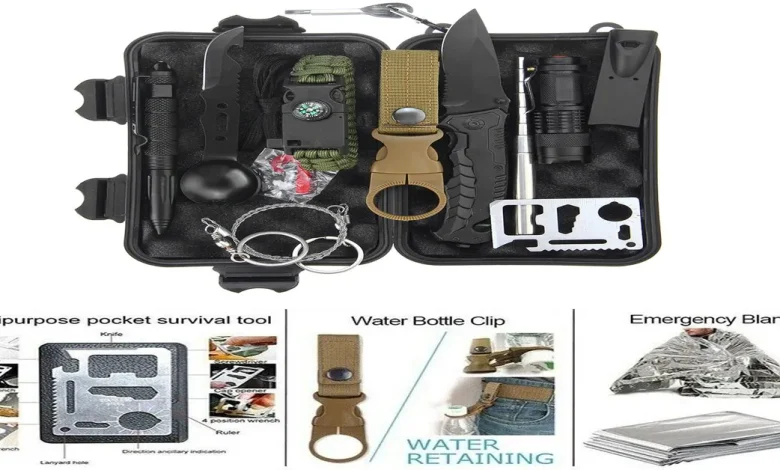
The 10 Pocket Survival Gear Items Worth Carrying
1. A Quality Folding Knife
This one isn’t controversial. A compact folding knife something with a blade under three inches covers more survival scenarios than almost anything else on this list. Cutting cordage, preparing tinder, field-dressing small game, first aid, making a shelter stake. The knife does it all.
I used to carry a cheap gas station folder because I thought “any knife is a knife.” That is genuinely bad logic. A blade that folds shut on your fingers because the lock failed is worse than no blade at all. Spend the extra thirty dollars. You’ll thank yourself.
2. A Mini Lighter (BIC, Not Fancy)
Everyone wants to recommend a fancy windproof torch lighter. And sure, those are great until the fuel runs out and you’re holding a useless piece of metal.
A standard BIC mini lighter is boring, reliable, and cheap enough to keep two in rotation. Fire is your first priority in almost every survival situation. Hypothermia kills faster than dehydration. Don’t overthink this one.
3. A Ferrocerium Fire Starter
But carry a ferro rod too. Not instead of the lighter alongside it. Lighters fail in wet conditions. Ferro rods work when they’re soaking wet, frozen, or covered in mud. They’re also essentially impossible to “run out of” in any realistic survival window.
The small ones we’re talking keychain-sized are perfectly functional. You don’t need the big survival-influencer version.
4. A Compact Multitool
A full-size multitool is heavy and lives in your bag. But Leatherman and a few other brands make genuinely pocket-friendly options flat, lightweight, with pliers, a small blade, a screwdriver, and scissors. These are the four things you’ll reach for when something goes sideways.
Here’s the thing most people skip: the scissors on a multitool are surprisingly useful for first aid. Cutting bandage material, removing clothing from an injured area without moving the limb. Small detail. Big deal in the field.
5. A Paracord Bracelet (Worn, Not Packed)
I know. I know paracord bracelets have become a little cliché. But the reason they got popular is because they actually work. Eight to twelve feet of 550 paracord on your wrist means you always have cordage for shelters, snares, lashing, tourniquet reinforcement, or hanging a food cache.
Wear it. That’s the whole point. It doesn’t count if it’s in a drawer.
6. A Signal Mirror
This is the one people consistently underestimate. A small glass signal mirror the size of a credit card, weighing almost nothing can reflect sunlight to a search aircraft from over ten miles away. Ten miles. Your whistle doesn’t do that. Your phone doesn’t do that if the battery’s dead.
I carried one for years without ever needing it. Then I was on a backcountry trip in Montana when a helicopter passed about two miles out. I had it out and flashing in seconds. They didn’t see me but I knew I had a real shot. That feeling alone was worth the two ounces.
7. A Loud Whistle
Three blasts. Universal distress signal. A quality pea-less whistle Fox 40, Storm, or similar can be heard clearly over a quarter mile in open terrain, even in wind. Your voice gives out. Your whistle doesn’t.
Clip it to a zipper. Forget it’s there. Be glad it’s there when you need it.
8. A Small LED Flashlight
Not your phone flashlight. An actual dedicated pocket flashlight. Phones die. Phone batteries drain in cold weather at a genuinely alarming rate something I learned on a December trail run when my phone went from 40% to dead in about twenty minutes at 18°F.
A small AAA-powered LED torch stays in your pocket and runs for hours. It also keeps your phone battery available for actual communication.
9. A Fresnel Lens or Mini Compass
Pick one based on your environment. If you’re in sun-heavy terrain, a credit-card Fresnel lens is a backup fire-starting method and doubles as a magnifier for reading maps or examining a wound. If you’re in dense forest or overcast regions where navigation is a bigger risk than fire, a quality button compass not a toy, an actual liquid-filled compass earns its place.
Both fit in a wallet. Both weigh nothing. Neither requires batteries.
10. Water Purification Tablets
A small foil packet of iodine or chlorine dioxide tablets takes up less space than a pack of gum. It won’t make creek water taste great nothing will but it will make it safe to drink, which is the only thing that matters when dehydration starts affecting your judgment.
And it will affect your judgment. That’s not dramatic, that’s just physiology.
What I’d Drop If I Had to Choose
Here’s where I’ll say something slightly unpopular: if you can only carry five items, skip the paracord bracelet and the Fresnel lens first. Cordage can often be improvised from natural materials if you have a knife. Fire from a lens requires direct sunlight and patience you might not have.
But the lighter, the knife, the whistle, the signal mirror, and the water tablets? Those five cover the four things that actually kill people in survival situations hypothermia, injury, dehydration, and failure to be found. Everything else is a bonus.
Can you really be “prepared” without a 40-pound bag? I’d argue yes if you’re smart about what you put in your pockets.
The best survival kit is the one that’s actually on you.
Jake would agree. He’s also the first person I know who now keeps a signal mirror clipped to his zipper every single time he heads into the backcountry. Funny how a flooded creek changes your priorities.