There’s a moment every angler knows standing at the edge of the water, rod in hand, watching the line slice through the surface. In that moment, the line isn’t just a piece of equipment. It’s the only physical connection between you and whatever’s down there. And yet, for something so critical, the conversation around choosing between braided and fluorocarbon line remains surprisingly muddled. Online forums swing between passionate loyalty and outright contradiction. Tackle shop employees give you different answers depending on the day. So let’s actually work through this not with a checklist, but with the kind of honest, experience-backed thinking that helps you make a decision you can trust on the water.
The Fundamental Difference Nobody Explains Clearly Enough
Most comparisons between braided and fluorocarbon line start with specs diameter, pound test, stretch percentage. Those numbers matter, but they don’t tell the whole story unless you understand what’s producing them.
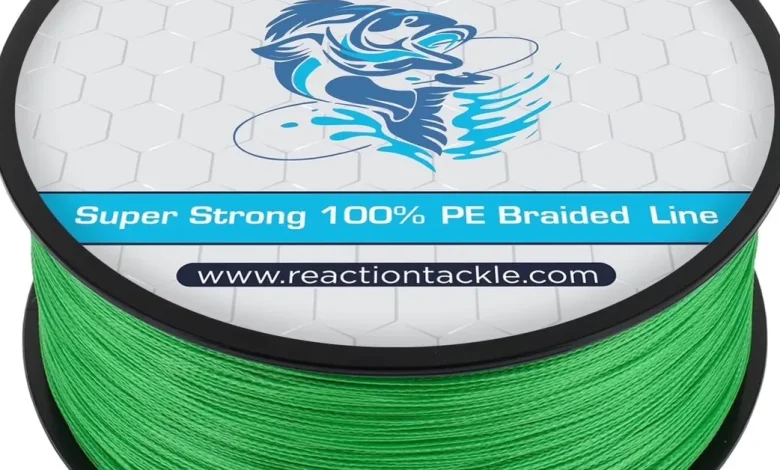
Braided line is exactly what it sounds like: multiple strands of synthetic fiber, typically Dyneema or Spectra, woven together. That construction is what gives braid its legendary strength-to-diameter ratio. A 30-pound braid is often thinner than a 10-pound monofilament. The weave also means virtually zero stretch, which translates directly into sensitivity you feel everything, from the tick of a lure dragging across gravel to the subtlest pressure bite from a finicky bass.
Fluorocarbon is a different animal entirely. It’s a single-strand line made from polyvinylidene fluoride, a dense polymer with a refractive index remarkably close to water. That last part is why fluorocarbon earned its reputation for invisibility light passes through it in a way that makes it nearly disappear below the surface. It also sinks faster than mono, resists abrasion reasonably well, and has moderate stretch that acts as a shock absorber during aggressive hook sets or sudden runs.
These aren’t competing versions of the same thing. They’re built for different jobs, and conflating them is where most anglers go wrong.
Where Braid Actually Earns Its Keep
If you’ve ever fished heavy cover thick grass mats, layered brush piles, dense timber you already know why braid exists. The zero-stretch property that makes braid feel almost telepathic also gives you the mechanical leverage to pull fish out of places that would snap lesser lines before you could even react. A 65-pound braid through a frog presentation over matted vegetation isn’t overkill. It’s engineering.
Beyond the power fishing applications, braid shines in deep water situations where stretch would otherwise muffle your connection to the bottom. Jigging for walleye at 40 feet or working a blade bait in cold, deep reservoirs that’s where the sensitivity of braid pays off in ways that fluorocarbon simply can’t match. You’re not just feeling bites. You’re reading the bottom composition, tracking your lure’s action, building a picture of what’s happening far below the surface.
There’s also the matter of casting distance. Braid, because of its thin diameter and limpness, loads a spinning reel differently than fluorocarbon. Long casts become easier, and that matters enormously in open water scenarios clear lakes, coastal flats, situations where approaching fish closely enough to reach them on shorter casts would spook them entirely.
The honest downside? Braid is visible. Not just somewhat visible it’s obvious. In clear water, a fish can see your line, and that changes behavior. Experienced anglers work around this by using a fluorocarbon leader, typically 12 to 24 inches of clear material tied between the braid mainline and the lure. It’s a practical compromise, though it introduces a knot connection that requires attention and skill to execute reliably.
The Case for Going All Fluorocarbon
Fluorocarbon has a particular kind of advocate the finesse angler. Drop shot rigs, shaky heads, Ned rigs, Neko rigs. All of these presentations are built around the idea of subtle, natural movement and minimal visual intrusion. Fluorocarbon serves that philosophy directly.
In gin-clear water, the invisibility factor is not a marketing claim. It’s measurable. Studies on fish behavior in pressured, clear-water environments consistently show that line visibility affects strike rates. Trout in spring-fed streams, smallmouth in rocky highland rivers, bass in heavily fished tournament lakes these fish have seen enough lures to develop something resembling wariness. The less line they can detect, the more naturally they’ll interact with your presentation.
Fluorocarbon also behaves differently underwater in terms of how it interacts with current and structure. Because it sinks and has more inherent stiffness than mono, it maintains better contact with the bottom on dragging presentations. A Carolina rig fished on fluorocarbon tracks differently than the same rig on braid there’s a directness to it, a groundedness, that many anglers find easier to interpret.
The stretch, which braid advocates often cite as a weakness, is genuinely a feature in certain contexts. When a large fish surges on a light wire hook, that 25 to 30 percent stretch in fluorocarbon acts as a buffer. Braid, with no give, can straighten hooks or tear through soft mouth tissue during those same surges. Trout anglers and panfish specialists often prefer fluorocarbon for exactly this reason.
The real limitation of fluorocarbon is memory. It tends to coil, particularly in cold temperatures, and that coiling creates problems on spinning reels wind knots, line twist, frustrating tangles at the worst possible moments. Baitcasters handle fluorocarbon more gracefully, which is why you’ll often see it spooled directly on casting reels for applications like flipping and pitching, where the stiffness actually helps with accuracy.
The Conditions That Should Drive Your Decision
Water clarity is probably the single most important variable. Stained or murky water largely neutralizes fluorocarbon’s visibility advantage, which means you’re paying a premium for a property you’re not using. In those conditions, braid possibly without a leader often makes more practical sense. Clear water flips the equation entirely.
Cover density matters just as much. If you’re fishing open water or sparse structure, fluorocarbon’s abrasion resistance is generally adequate. Introduce heavy wood, rock, or vegetation, and braid’s superior strength-to-diameter ratio and cut-through capability become significant advantages.
Think about the technique, not just the target species. A largemouth bass caught on a topwater walking bait in open water might actually be better served by braid for casting distance and hook-setting power. The same largemouth targeted with a drop shot in 20 feet of clear water is almost certainly a fluorocarbon situation. The fish hasn’t changed. The presentation has.
And then there’s the question of feel versus forgiveness. Braid gives you more information. Fluorocarbon gives you more margin for error. Neither of those is universally superior it depends on your skill level, your fishing style, and what you’re actually asking the line to do.
The Line You Trust Is the Line You Understand
There’s a tendency in fishing culture to treat gear decisions as identity statements. Braid loyalists and fluorocarbon devotees can both sound like they’re defending a worldview rather than discussing a tool. The truth is more practical and less satisfying: both lines are excellent at specific tasks, and the anglers who get the most out of each are the ones who’ve taken the time to understand the mechanics behind them.
The question isn’t really which line you should trust. It’s whether you’ve put in enough time with each to know what they’re actually telling you and whether you’re honest enough with yourself to match the tool to the situation rather than the situation to the tool you happen to prefer.