The Life of a Fishing Guide’s Gear: What Survives 300 Days a Year
Not a Hobby. A Livelihood Built on Equipment That Can’t Fail.
There’s a version of fishing gear that lives in a garage, pulled out maybe a dozen times between Memorial Day and Labor Day. It gets rinsed, maybe. It gets stored in a climate-controlled space. It ages gracefully, like furniture.
Then there’s the other version the version that belongs to a fishing guide.
That gear doesn’t get a season. It gets a year. Three hundred days of sun, salt or freshwater, client misuse, dropped rods, tangled lines, and the kind of mechanical stress that no manufacturer stress-test truly replicates. A guide’s equipment doesn’t just get used. It gets consumed. And what survives that consumption tells you something honest about quality that no review site ever could.
The Rod: Where Compromise Becomes a Philosophy
Most recreational anglers obsess over rods. Guides do too, but for entirely different reasons. A weekend angler wants a rod that feels good. A guide needs a rod that survives being handed to someone who has never held one repeatedly, across hundreds of clients, across an entire career.
The first thing that goes on a guide’s rod isn’t the blank. It’s the guides themselves the small ceramic or titanium rings that line the rod and direct the line. On a rod that sees 300 days of use, those guides accumulate micro-grooves from constant line friction. A grooved guide will shred monofilament. It will fray fluorocarbon. It will cost a client a fish and a guide a tip. Most experienced guides inspect their guides the rings, not themselves with a cotton swab trick: drag a cotton ball through each ring and watch for snags. They do this constantly. Some do it weekly.
The blank itself, that long tapered spine of graphite or fiberglass, is more resilient than people assume, until it isn’t. Graphite is strong in one direction and catastrophically fragile when stressed laterally. Guides who work in boats with low overhangs, or who fish tight river corridors with trees on both banks, know this intimately. A rod tip caught on a branch at the wrong angle doesn’t bend it detonates. The guides who last longest in the profession tend to migrate toward slightly softer, more forgiving blanks. Not because they want to. Because they’ve watched enough expensive fast-action rods snap in a client’s hands to understand that performance on paper and performance in the field are two different conversations.
Reels: The Honest Machines
A reel is a mechanical device. And mechanical devices have one universal truth: they will fail in direct proportion to how hard you use them and how inconsistently you maintain them.
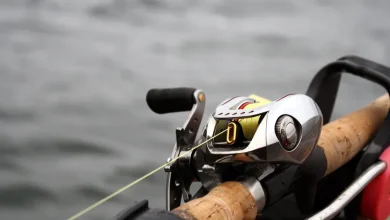
A guide’s reel might be engaged and disengaged thousands of times in a single week. The drag system that carefully calibrated mechanism that lets fish run without breaking the line takes the most punishment. Cheap drag systems use felt washers that compress and harden over time, becoming inconsistent. Better systems use carbon fiber or cork composites that hold their profile longer. Guides know this not because they read about it, but because they’ve handed a reel with a failing drag to a client fighting a large fish and watched what happens next. The line snaps. The fish is gone. The client is disappointed. The guide is quietly furious.
Saltwater guides face a dimension that freshwater guides don’t: corrosion. Salt is patient and relentless. It finds every unsealed bearing, every exposed screw, every gap in a housing. A reel that isn’t rinsed with fresh water at the end of every single day will begin to seize within a season. Guides who work inshore flats or offshore charters often go through reels the way other professionals go through printer ink regularly, resignedly, budgeting for it. The reels that survive are the ones built with sealed bearings, corrosion-resistant alloys, and this matters more than people admit simple enough internal architecture that a guide can service them in a motel room with a screwdriver and a bottle of reel oil.
Line: The Component Nobody Respects Enough
Line is the most replaced and most underestimated piece of equipment in a guide’s kit. It is also, in a practical sense, the most important because it is the only physical connection between the angler and the fish.
Monofilament degrades with UV exposure. It loses tensile strength. It develops memory, coiling off the reel in tight spirals that create slack and reduce sensitivity. A guide who leaves monofilament on a reel through an entire season is making a quiet gamble every single day. Most experienced guides strip and replace their main line far more frequently than the packaging would ever suggest some do it monthly during peak season, some after every particularly brutal day of heavy use.
Braided line is more durable in terms of UV resistance and tensile consistency, but it introduces its own complications. It cuts skin. It cuts through rod guides faster than monofilament under friction. And it has essentially no stretch, which means that any shock a sudden run, a client who jerks the rod transfers directly to the hook set and the tippet. Guides who use braid almost universally pair it with a fluorocarbon leader, which adds the invisible stretch buffer that keeps the system from being too brutal.
Leaders and tippets are, in the guide world, essentially disposable. They get replaced constantly, sometimes mid-session, without ceremony or sentiment.
The Gear Nobody Photographs: Pliers, Nets, and the Stuff That Just Works
The glamorous gear gets the attention. The rods get the Instagram posts. But ask any guide what piece of equipment they’d be most crippled without, and a surprising number will say their pliers.
A good pair of fishing pliers the kind with a tungsten carbide cutter, a crimping jaw, and a grip that doesn’t slip when your hands are wet and cold gets used dozens of times a day. Cutting line. Removing hooks from fish. Crimping leaders. Bending hook points. The cheap ones corrode, the jaws loosen, the cutters dull within a season. The good ones certain brands have earned almost cult status among working guides last for years. They get dropped overboard and retrieved. They get left in the rain. They keep working.
Landing nets are similar. The frame takes abuse. The mesh, if it’s the old knotted nylon style, damages fish scales and removes the protective slime coat which matters to guides who run catch-and-release operations, because a damaged fish is a dead fish eventually, and a dead fish is a conservation problem and a reputation problem simultaneously. Rubber mesh nets, which are gentler on fish and resist the odor absorption that makes old nylon nets smell like something died in them (because something did), have become standard among serious guides. The good ones cost more. They last longer. The math works out.
What Survival Actually Means
Here’s the thing that doesn’t show up in gear reviews: the equipment that survives 300 days a year in a guide’s hands isn’t always the most expensive. It isn’t always the most technically advanced. What survives is the gear that was designed with actual use in mind rather than theoretical performance gear that can be maintained in the field, repaired without sending it back to a factory, and trusted when the conditions are bad and the client is watching.
Guides develop a kind of equipment intuition that takes years to build. They know which rod will survive being leaned against a truck door by accident. They know which reel drag will hold at 4 a.m. in November when the temperature is dropping and the fish don’t care. They know which line to trust when everything else is going wrong.
That knowledge doesn’t come from spec sheets. It comes from the slow, expensive, occasionally heartbreaking process of finding out what breaks and quietly noting what doesn’t.