You’re halfway up a ridge, wind picking up, and you spot movement in the tree line below. You reach for your binoculars and they’re swinging somewhere behind your left hip, tangled in your pack strap, completely useless for the next thirty seconds. The moment’s gone. So is whatever was in those trees.
That’s the whole story, really. But let’s unpack it.
The Piece of Gear Nobody Talks About Enough
Ask any serious birder, hunter, or wildlife photographer what their most important piece of optical gear is, and they’ll tell you it’s the binoculars. Fair enough. But push a little harder ask them what actually determines whether those binoculars get used at the right moment and most of them go quiet.
The binocular harness. That’s the answer.
Not the glass itself. The thing holding the glass.
I know that sounds like I’m overselling a glorified strap system. But stick with me, because I’ve watched this play out too many times to dismiss it as coincidence.
What a Neck Strap Actually Costs You
For years embarrassingly many years I used the standard neck strap that came bundled with my binoculars. It was fine. It did the job in the loosest possible definition of “the job.” My binoculars were attached to my body, technically.
But here’s what I didn’t account for: a neck strap doesn’t stabilize anything. It lets your optics bounce against your chest with every step, which means you’re subconsciously pressing them against your body with one hand just to stop the noise and movement. That’s one hand that isn’t free for trekking poles, a camera, or grabbing a branch on a steep trail. Over a six-hour day in the field, that adds up to a kind of low-grade exhaustion you can’t quite name.
And then there’s the access problem. Neck straps keep binoculars dangling at chest level, which sounds convenient until you’re bending over a creek, leaning through brush, or crawling into a blind. Suddenly your optics are dragging in the mud or swinging forward and cracking against a rock.
I actually cracked a lens cap that way. It was a $400 pair of binoculars and a $3 lens cap, but still not the point.
Why the Harness Changes Everything
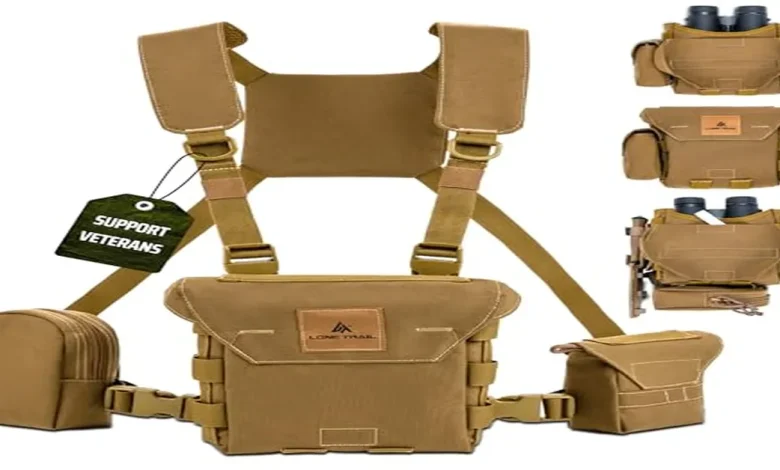
A proper binocular harness the kind with an elastic strap system that distributes weight across your shoulders and chest solves problems you didn’t even know you had.
The binoculars sit flat against your chest. Not swinging, not bouncing. You barely notice they’re there after the first twenty minutes. Both hands stay free. And when you need them, you pull them up to your eyes in one clean motion. No untangling. No readjusting. No lost seconds.
Those lost seconds matter more than most people admit. Wildlife doesn’t wait. A raptor crossing an open sky, a buck stepping out of cover, a warbler flitting through the canopy these windows are measured in seconds, sometimes less. The difference between a harness and a neck strap is often the difference between seeing something and seeing where it was.
But here’s the part that catches people off guard: the harness also changes how long you stay out.
Comfort Is a Tactical Advantage
My friend Marcus he guides elk hunts in Colorado made this point better than I ever could. He told me once that he could tell within the first hour of a trip whether a client was going to have a good experience, just by watching how they handled their optics.
“If they’re fighting their gear,” he said, “they’re not watching. And if they’re not watching, they’re not seeing anything.”
He’s right. Physical irritation redirects attention. A neck strap that’s digging into your cervical spine after four hours isn’t just uncomfortable it’s pulling your focus away from the environment and toward your own body. You start thinking about the strap instead of the hillside.
A harness that fits well disappears. That’s the goal. Gear that disappears.
Not All Harnesses Are Worth Your Time
Here’s where I’ll pump the brakes a little, because not every harness on the market deserves the praise I’m handing out.
Cheap elastic systems lose their tension after a season or two and start letting the binoculars bounce again which defeats the whole purpose. Some designs position the binoculars too low on the chest, which means you’re still doing an awkward reach-and-lift every time. And a few harnesses I’ve tried have chest buckles that clip right where a pack’s sternum strap needs to sit, so you end up in a weird negotiation between two pieces of gear that should never have to compete.
The brands that consistently get it right and I’m not going to turn this into an ad tend to be the ones designed by people who actually spend time in the field. You can usually tell by whether the quick-release clips feel intuitive in gloves. If you have to look down to figure out the clip, it’s the wrong harness.
The Counterintuitive Truth About “Simple” Gear
Here’s the slightly controversial take: the simpler and cheaper a piece of gear looks, the more important it often is to get it right.
People will agonize for months over which binoculars to buy reading reviews, comparing glass quality, debating roof prism versus porro prism and then slap whatever strap came in the box onto a $600 pair of optics and call it done. It’s backwards. The harness is the interface between you and the glass. A mediocre harness degrades a great pair of binoculars in practice, even if the optics themselves are perfect.
Think about that for a second. You’re not just buying glass. You’re buying a system. And a chain, as they say, is only as strong as its weakest link.
Finding the Right Binocular Harness for Your Style
What works for a birder doing slow walks through wetlands is different from what works for a backcountry hunter covering ten miles a day. The former might prioritize a softer, padded design for comfort during long stationary periods. The latter needs something that plays well with a pack, stays put on technical terrain, and can be operated one-handed without looking.
Try the harness on before you buy it if you can with your actual binoculars clipped in, and ideally with the pack you usually carry. The fit changes dramatically once everything is loaded. What feels fine in a store aisle feels completely different on mile four of a switchback trail.
And if you’re somewhere between these use cases? Honestly, I’d lean toward the more minimal, lower-profile harness. Easier to adapt than to strip down.
Your Binoculars Are Only as Good as Your Access to Them
The best optics in the world, sitting at the wrong angle on the wrong strap at the wrong moment, are just expensive weight. Your binocular harness determines whether your glass is a reactive tool you fumble for or an extension of your own vision that’s just always there, always ready.
Get the harness right first. Then obsess over the glass.