The Weight Problem Nobody Talks About
There’s a moment every serious angler knows standing at the edge of a dock, or knee-deep in a river that keeps pulling your line sideways, when you realize the lead sinker you’ve been fishing with for fifteen years simply isn’t doing what you need it to do. It’s not a dramatic revelation. It usually arrives quietly, in the form of a missed strike, a snag you couldn’t feel coming, or a presentation that landed three feet from where you intended. The gear isn’t broken. It just isn’t right.
That’s usually the moment tungsten enters the conversation.
Tungsten weights have been around long enough that they’re no longer a novelty, but they’re still misunderstood in a way that prevents a lot of anglers from making the switch at the right time or making it at all. The conversation tends to collapse into price comparisons, which is the least interesting part of the story. The real question is situational: when does the physics of tungsten actually change what’s possible on the water?
What Tungsten Actually Is, and Why It Behaves Differently
Tungsten is roughly 1.7 times denser than lead. That single fact drives everything else. A tungsten weight of a given size carries significantly more mass than its lead equivalent which means you can fish the same weight in a dramatically smaller package, or fish a heavier load without the bulk that disrupts your presentation.
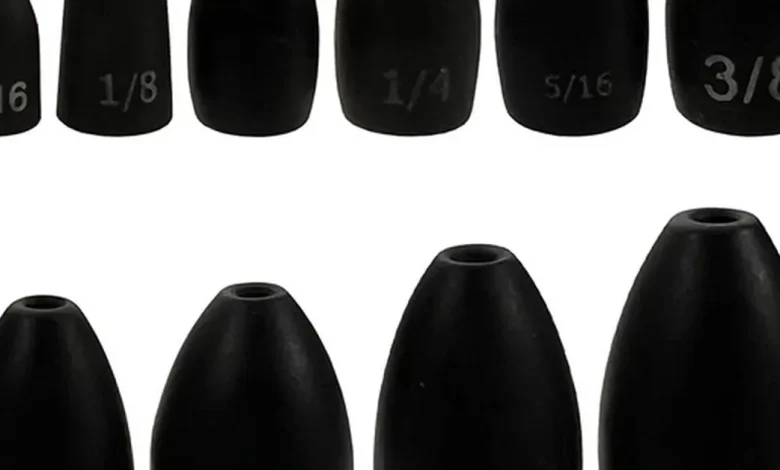
In practical terms, a 3/8-ounce tungsten bullet weight is about the physical size of a 3/16-ounce lead weight. That difference sounds modest until you’re punching through thick hydrilla mats or trying to keep a Texas-rigged soft plastic tracking straight through laydowns. The smaller profile slips through cover with less resistance. It creates less disturbance on entry. And it sits on the bottom in a way that looks, to a bass, more like something that belongs there.
Density also affects sensitivity in a way that’s harder to quantify but immediately felt. Tungsten transmits vibration more efficiently than lead. When your weight ticks off a rock, brushes a root, or settles into gravel versus mud, that information travels up the line faster and with more clarity. Experienced anglers often describe the difference as going from a muffled signal to a clean one. You’re not just fishing you’re reading the bottom in real time.
The Conditions That Make the Case
Not every fishing situation demands tungsten. That’s an honest thing to say, and it matters. In open water, casting a drop shot over sandy flats, or fishing a Carolina rig in a lake with minimal structure, lead does the job. The sensitivity advantage narrows when there’s nothing complex to feel, and the size difference becomes irrelevant when cover isn’t a factor.
But certain conditions push tungsten from a preference into something closer to a necessity.
Heavy cover is the clearest case. When you’re flipping into thick grass, punching through matted vegetation, or working a jig through a rock pile, the compact profile of tungsten changes what’s physically possible. The weight penetrates where lead hangs up. It falls faster and more vertically through the canopy of a mat, which means your bait arrives at the strike zone the bottom of the mat, where bass are holding instead of getting intercepted halfway through.
Cold water fishing is another situation where the sensitivity advantage becomes decisive. Bass in cold water are lethargic. Their strikes are subtle, almost polite a slight pressure change, a line that moves an inch in the wrong direction. You need to feel everything. A tungsten weight in 45-degree water, on a finesse rig, gives you a margin of detection that lead simply can’t match. The angler who feels the difference between a bass mouthing the bait and a piece of debris catches fish that other anglers never know they had.
Clear water is a third scenario worth considering. In highly pressured, gin-clear lakes, fish have seen every presentation and learned to scrutinize what doesn’t look right. A smaller, less intrusive weight keeps the overall profile of your rig cleaner. It’s not that bass can identify tungsten they can’t but a compact weight allows the soft plastic to move more naturally, with less anchor effect dragging the tail down awkwardly.
Tournament Fishing and the Marginal Edge
In competitive angling, the conversation around tungsten sharpens considerably. Tournament anglers operate in a world where the difference between first place and fifth place is sometimes a single fish, or a single ounce. In that context, every marginal advantage compounds.
The sensitivity argument carries particular weight no pun intended in tournament settings because information is time. A tournament angler who can identify bottom composition faster, detect strikes more consistently, and make confident decisions about where to move and where to stay is fishing more efficiently across an eight-hour day. Over a three-day event, that efficiency adds up.
There’s also a psychological dimension that doesn’t get discussed enough. Fishing with gear you trust changes how you fish. When you believe you’re feeling everything that’s happening at the end of your line, you commit to presentations more fully. You hold the bait in the strike zone longer. You don’t second-guess the retrieve. Confidence in your equipment is a real, if unmeasurable, variable in performance.
The Price Conversation, Done Honestly
Tungsten costs more. Meaningfully more sometimes three to five times the price of comparable lead weights. For a recreational angler who loses a dozen weights per outing to snags, that math can feel prohibitive.
But the calculation deserves more nuance than a straight price comparison. Tungsten is harder than lead, which means it resists nicking and deforming. A tungsten weight that survives a hundred casts through rock looks essentially the same as it did on the first cast. Lead, by contrast, accumulates damage that affects its performance and eventually requires replacement.
The loss rate also changes with experience and technique. Anglers who fish tungsten tend to develop a more tactile relationship with their rig they feel snags developing before they become catastrophic, and they work the weight free more often. It’s not that tungsten is snag-proof; it’s that the feedback it provides gives you more opportunities to respond.
For the angler who fishes specific high-stakes situations heavy cover, tournaments, cold-water finesse the cost-per-fish calculation shifts. For the angler who’s mostly casting in open water for fun, the upgrade may never pay for itself in any meaningful way.
Making the Switch Without Overthinking It
The practical path forward doesn’t require converting your entire tackle box overnight. Most experienced anglers who’ve made the transition recommend starting with the scenarios where tungsten’s advantages are most pronounced a flipping setup for heavy cover, or a finesse rig for cold-water situations and building familiarity from there.
What tends to happen is that the first time you feel a subtle strike that you would have missed with lead, or watch your bait fall through a mat that would have eaten your old weight, the theoretical advantages become concrete. The switch stops feeling like an upgrade and starts feeling like a correction.
There’s something worth sitting with in that idea. Fishing gear exists on a spectrum of adequacy, and most of us fish comfortably within it for years without knowing what we’re not feeling. Tungsten doesn’t make you a better angler. But it removes a layer of noise between you and the water and in certain moments, on certain days, that clarity is exactly the difference between a story you get to tell and one you never knew was there.