Is It Luck or Logic? Breaking Down the Rituals of Successful Anglers

The Myth of the Lucky Fisherman
There’s a guy at every lake. You’ve seen him. He shows up in a beat-up truck, ties on whatever lure is closest to hand, casts without much ceremony, and pulls in fish after fish while you’ve been methodically working the same stretch of water for three hours with nothing to show for it. The easy explanation the one most of us reach for is luck. He got lucky. The fish happened to be there. The stars aligned.
But spend enough time around serious anglers, and that explanation starts to fall apart. The guy with the beat-up truck has been fishing that lake for twenty-two years. He knows where the thermocline drops in August. He knows which side of the dock holds bass after a cold front. What looks like effortless luck from the outside is a dense, internalized library of pattern recognition that he stopped consciously thinking about long ago.
This is where the luck-versus-logic debate gets genuinely interesting not because luck doesn’t exist, but because what we call luck in fishing is usually just expertise operating below the surface of visibility.
What Rituals Actually Do
Ask any experienced angler about their pre-fishing routine and you’ll hear things that sound, on the surface, almost superstitious. Always starting with a specific lure. Checking the wind before touching the tackle box. Spending the first fifteen minutes just watching the water. Some of these habits have obvious scientific grounding. Others seem more like personal mythology.
The distinction matters less than you’d think.
Rituals even ones that don’t have direct mechanical explanations serve a cognitive function. They slow the angler down. They create a transition between the noise of daily life and the focused, receptive state that good fishing actually requires. A person who goes through a deliberate pre-cast checklist isn’t being superstitious; they’re priming their attention. They’re telling their brain: we’re switching modes now. Pay attention to different things.
There’s research in sports psychology that supports this. Pre-performance routines reduce anxiety, increase consistency, and help athletes access what psychologists call “automaticity” the state where practiced skills run smoothly without conscious interference. Fishing isn’t so different from a free throw. The ritual isn’t magic. It’s a delivery mechanism for focus.
Reading Water Is a Learnable Language
One of the most significant divides between casual anglers and consistently successful ones isn’t equipment, and it isn’t even technique. It’s the ability to read water.
A stretch of river that looks uniform to an untrained eye is actually a complex conversation between current, depth, temperature, structure, and food supply. The eddy behind a submerged boulder. The seam where fast water meets slow water. The way a shadow line from an overhanging tree creates a temperature differential that holds trout on a hot afternoon. These aren’t secrets they’re patterns, and they’re learnable.
The challenge is that learning to read water takes time and a particular kind of attention. You have to be willing to fish badly for a while. You have to cast into spots that feel wrong based on instinct and then adjust your mental model when you’re surprised. You have to lose fish and ask why, rather than chalking it up to bad luck and moving on.
Experienced anglers develop what you might call spatial memory for water. They remember not just where they caught fish, but what the conditions were the barometric pressure, the water clarity, the time of day, the season, the temperature trend over the preceding week. Over years, this accumulates into something that genuinely looks like intuition but is actually pattern-matched prediction.
The Role of Gear Overrated and Underrated at Once
The fishing industry runs on the promise that the right equipment will transform your results. New rod technology. Lures engineered to mimic the exact vibrational frequency of a wounded baitfish. Electronics that map the bottom of a lake in real time and mark fish with unsettling precision.
Some of this matters. A lot of it doesn’t, or at least not in the way the marketing suggests.
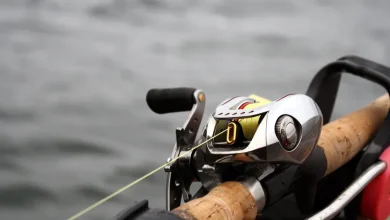
Where gear genuinely earns its keep is in reducing friction between intention and execution. A rod that matches your casting style means your presentation lands where you intend it to. A reel with a smooth drag means you don’t lose fish to mechanical failure at the critical moment. Line that matches the conditions fluorocarbon in clear water, braided line when you need sensitivity in heavy cover can make a real difference in whether fish commit or spook.
But the angler who obsesses over gear as a substitute for understanding fish behavior is working backward. The most effective lure in the world, presented in the wrong location at the wrong time, catches nothing. Meanwhile, a mediocre lure fished in exactly the right spot, at the right depth, with the right retrieve, catches fish. The gear is downstream of the decision-making. It executes the strategy; it doesn’t create it.
Consistency Versus the Highlight Reel
Social media has done something strange to the perception of fishing skill. What gets shared is the exceptional catch the trophy bass, the massive haul, the fish that breaks a personal record. What doesn’t get shared is the six hours of methodical, patient, largely uneventful fishing that preceded it.
This creates a distorted picture of what consistent success actually looks like. The anglers who catch fish regularly aren’t the ones who get lucky on spectacular days. They’re the ones who show up prepared, adapt to conditions, manage their expectations, and extract value from days that would send a less experienced person home empty-handed.
There’s a concept worth borrowing from professional gambling: expected value. A skilled poker player doesn’t win every hand. They make decisions that are correct given the available information, and over enough repetitions, those correct decisions produce better outcomes than chance alone would predict. Fishing works similarly. The skilled angler doesn’t catch fish every cast. They position themselves in situations where the probability of success is higher than average, and they execute with enough consistency that the math eventually works in their favor.
Bad days happen. Conditions turn. Fish don’t cooperate. The difference is that the skilled angler doesn’t experience a slow day as a referendum on their ability. They’re running a longer calculation.
When Luck Does Show Up
None of this is to say luck is fiction. It shows up, genuinely and unpredictably. A school of stripers pushes bait to the surface exactly where your boat happens to be drifting. A storm front you didn’t see coming triggers a feeding frenzy that turns an ordinary afternoon into something extraordinary. You tie on a lure on a whim and it happens to match a hatch you didn’t know was happening.
These moments are real. They’re also, in a strange way, more available to prepared anglers than to unprepared ones. Not because preparation summons luck that would be superstition but because a prepared angler is positioned to recognize and capitalize on unexpected opportunity. They notice the birds working the surface. They have the right gear rigged and ready. They know how to adjust quickly when conditions shift.
The old saying that luck favors the prepared is a cliché precisely because it keeps being true. Opportunity is distributed somewhat randomly. The ability to convert it is not.
The Angler’s Quiet Epistemology
What makes fishing philosophically interesting and this might sound like a stretch, but stay with it is that it forces a continuous negotiation between what you know and what you don’t. The water keeps information from you. Fish are unpredictable. Conditions change faster than your mental model can update.
The best anglers aren’t the ones who are most certain. They’re the ones who hold their assumptions lightly, stay curious about why they’re wrong, and keep revising. They treat every trip as data, even the bad ones. Especially the bad ones.
That’s not luck. That’s a practice. And like most practices, it’s invisible from the outside which is probably why we keep calling it luck when we see it from the bank.