How Cycling Helps You Navigate Life’s Toughest Transitions
The Road Doesn’t Care About Your Problems And That’s the Point
There’s a particular kind of silence you find at mile six of a long ride. The mental chatter that followed you out the door the anxiety about a job you just lost, the grief sitting heavy in your chest, the dread of a life that no longer looks like the one you planned starts to thin. Not because the problems disappear. They don’t. But the road demands something from your body, and when your body is fully occupied, your mind finally gets a moment to breathe.
People talk about cycling as exercise. That’s true, but it’s also a little like calling a cathedral a building. Technically accurate. Wildly insufficient.
For anyone standing at one of life’s genuinely difficult crossroads a divorce, a career collapse, a health diagnosis, the death of someone central to your world cycling offers something that therapy, journaling, and well-meaning advice often can’t quite reach. It offers a physical metaphor that you live inside, in real time, with your own legs doing the work.
Why Transitions Break Us And What We Actually Need
Life transitions are disorienting not just because they’re painful, but because they dissolve structure. When you lose a job, you lose a schedule. When a relationship ends, you lose a shared future you’d already half-imagined. When your health changes, you lose the casual confidence of a body you thought you understood. The ground shifts, and suddenly you’re not sure where to put your weight.
What most people need during a transition isn’t motivation. It’s not a five-step plan. It’s something more elemental: a sense of forward motion, a reason to get up, and proof real, embodied proof that they’re still capable of doing hard things.
Cycling delivers all three with unusual efficiency.
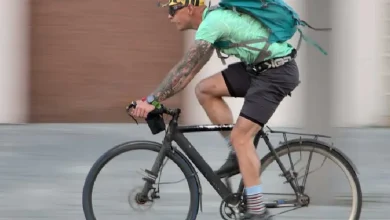
A bike doesn’t let you stand still. The physics of the thing require you to keep moving or fall over. There’s something almost absurdly literal about that life in transition asks the same thing of you, and the bike makes you practice it every single day. You clip in, you push, and the world moves past you. Whatever you’re carrying, you’re still moving through it.
The Discipline That Doesn’t Feel Like Discipline
One of the cruelest aspects of major life change is what it does to your relationship with routine. The structures that once organized your days vanish, and building new ones from scratch requires a kind of willpower that grief and stress actively deplete. This is why so many people in transition describe feeling paralyzed not lazy, not weak, just genuinely unable to manufacture motivation from nothing.
Cycling sidesteps this trap in an interesting way. The commitment to a ride is small enough to make. You don’t have to rebuild your entire life today. You just have to get on the bike. But the cumulative effect of that small commitment, repeated over weeks and months, is enormous. You start to have somewhere to be in the morning. You start to have something to look forward to. The ride becomes an anchor point around which the rest of the day can organize itself.
A woman named Rachel, who went through a brutal divorce in her early forties, described it this way: she didn’t start cycling because she thought it would help. She started because a friend dragged her out on a Saturday morning and she had nothing better to do. But within six weeks, the ride had become the one non-negotiable in her week. Everything else was uncertain her finances, her living situation, her sense of who she was without the marriage. The bike was certain. That certainty, she said, was the thread she held onto.
Suffering at a Manageable Scale
Here’s something that sounds counterintuitive until you’ve experienced it: choosing to suffer, in a controlled and voluntary way, can be profoundly healing when you’re in the middle of suffering you didn’t choose.
A steep climb hurts. Your lungs burn, your legs fill with lactic acid, and there’s a voice somewhere in the back of your head that makes a very reasonable case for stopping. But you don’t stop. You find something stubbornness, rhythm, the view at the top and you get through it. And then you’re through it. The climb is behind you. You did that.
This matters more than it sounds. When life puts you through something genuinely hard, one of the most insidious side effects is the erosion of self-trust. You start to wonder if you’re capable of handling what’s coming. Every difficult moment feeds the fear that you might not make it through. Cycling gives you a steady diet of small, conquerable difficulties. You accumulate evidence, ride by ride, that you can endure discomfort and come out the other side. That evidence doesn’t stay on the bike. It travels with you.
The Community You Didn’t Know You Needed
Grief and transition are isolating almost by design. The people around you have their own lives, their own rhythms, and even the most loving friends eventually run out of the right things to say. There’s a particular loneliness in being the person who’s still in the middle of something that everyone else has moved on from.
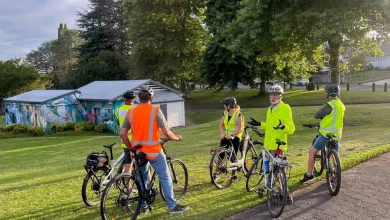
Cycling communities are strange and wonderful for precisely this reason. When you show up for a group ride, no one is asking about your divorce or your job search. They’re asking if you’ve tried the new route out past the reservoir. They’re complaining about headwinds. They’re arguing about tire pressure. The conversation is blessedly, almost aggressively mundane and for someone drowning in the significance of their own circumstances, that mundanity is a kind of relief.
You belong somewhere. Not because of your story, not because of your pain, but because you showed up with a bike and legs willing to work. The social mathematics of a cycling group are refreshingly simple, and simple is exactly what a complicated life sometimes needs.
What the Long Ride Teaches You About Time
There’s a particular quality of thought that emerges on a long ride somewhere past the first hour, when the early discomfort has settled into rhythm and the mind loosens its grip on whatever it was clenching. Cyclists call it different things. Some call it flow. Some just call it the good part.
In that state, your relationship with time changes. You stop thinking in terms of the whole problem the entire mountain of change you’re facing and start thinking in terms of the next mile, the next turn, the next drink of water. This is not avoidance. It’s something closer to the opposite: it’s learning to be present inside a difficult experience rather than fleeing from it or being crushed by it.
The long ride teaches, through repetition, that enormous distances are covered by paying attention to what’s directly in front of you. That lesson is not metaphorical. Or rather, it starts as a physical reality and slowly becomes something you carry into the rest of your life. The divorce isn’t one impossible thing. It’s a series of next steps. The career rebuild isn’t a mountain. It’s a series of pedal strokes.
Not a Cure Something Better
Cycling won’t fix what’s broken. It won’t bring back what you’ve lost or make the decisions ahead of you any easier. Anyone who tells you otherwise is selling something.
What it offers is more honest than a cure, and in some ways more valuable: a daily practice of forward motion, a community of people who ask nothing of your story, a body that grows stronger while your life is still figuring itself out, and on the good days, on the long climbs, on the quiet descents a few miles of proof that you are still here, still moving, still capable of choosing where you go next.
The road doesn’t care about your problems. But it will take you somewhere. And sometimes, that’s exactly what you need.