There’s a particular kind of humility that comes from a trail. You plan your route, pack your gear, check the weather twice and then the mountain does whatever it wants. A root catches your boot at mile four. A loose rock shifts under your heel on the descent. Your ankle rolls slightly, your hip compensates, and by the time you reach the trailhead again, something in your lower back is quietly filing a complaint.
Most hikers treat flexibility as a luxury, something reserved for people who do yoga in studios with good lighting. But flexibility, in the context of hiking, is closer to a survival skill. It determines how your body negotiates uneven ground, how quickly your muscles respond when the terrain demands something unexpected, and whether you finish a long day on your feet feeling capable or destroyed.
The connection between yoga and hiking isn’t new, but it’s still underutilized. Hikers tend to be pragmatic people they want training that translates directly to performance. Yoga can feel abstract, even indulgent. But strip away the incense and the Sanskrit, and what you’re left with is a system for building the exact qualities that uneven terrain demands: joint mobility, muscular balance, proprioceptive awareness, and the ability to stay calm when your body is under load.
These five poses address the specific physical demands of hiking. Not hiking in general hiking on terrain that doesn’t cooperate.
Low Lunge (Anjaneyasana): The Hip Flexor Reset
Every uphill step shortens your hip flexors. Every downhill step loads them differently. By the end of a long hike, those muscles the psoas, the iliacus, the rectus femoris are chronically contracted, pulling your pelvis forward and compressing your lower spine.
Low lunge is not a glamorous pose. It doesn’t photograph well and it doesn’t feel like much until it does. Start in a kneeling position, step your right foot forward so your knee stacks over your ankle, and let your left knee rest on the ground. Sink your hips forward and down. The stretch will arrive slowly, somewhere deep in the front of your left hip. Hold it there for sixty seconds, maybe ninety. Breathe into it rather than forcing it.
What makes this pose specifically useful for hikers is that it also builds single-leg stability. As you hold the lunge, your front leg is doing real work the glute is firing, the quad is engaged, the ankle is stabilizing. You’re not just stretching; you’re rehearsing the muscular coordination that every uphill step requires. Over time, this translates directly to more efficient climbing and fewer aches at the end of the day.
Warrior III (Virabhadrasana III): Balance Under Load
Uneven terrain is essentially a continuous balance test. Your body is constantly making micro-adjustments tiny shifts in weight, small corrections through the ankle and knee to keep you upright. Most hikers have never trained this capacity directly. They assume balance is something you either have or don’t.
Warrior III challenges that assumption. Standing on one leg, hinge forward from the hip until your torso and extended leg form a single horizontal line. Arms can reach forward, rest on your hips, or extend out to the sides whatever helps you find stability. The standing leg is doing everything: the foot is gripping the floor, the ankle is working, the glute is firing to hold the hip level.
What’s interesting about this pose is how quickly it reveals asymmetry. Most people discover they’re significantly more stable on one side than the other. That imbalance doesn’t disappear on the trail it shows up as compensatory patterns that eventually become pain. Practicing Warrior III on both sides, consistently, begins to correct those patterns before they become problems.
Hold for thirty to forty-five seconds. Wobble. That’s the point.
Lizard Pose (Utthan Pristhasana): Opening the Outer Hip
The outer hip the gluteus medius, the piriformis, the deep rotators is where hikers hold tension they don’t know about. These muscles stabilize the pelvis with every step. On flat ground, they work steadily and quietly. On rocky, uneven ground, they’re working overtime, constantly adjusting to keep your pelvis from tipping side to side.
Lizard pose goes deeper than low lunge. From a low lunge position, walk your front foot out to the edge of your mat and lower your back knee to the ground. Bring both forearms down to the floor inside your front foot. If that’s too intense, keep your hands on blocks or on the ground with straight arms. Either way, you’ll feel this in the outer hip of the front leg and the hip flexor of the back leg simultaneously.
This dual action is what makes lizard particularly valuable. You’re not just stretching one thing in isolation you’re opening a whole chain of tissue that runs from the hip through the thigh. After a long day of scrambling over boulders or navigating switchbacks, this pose is the one that makes hikers audibly exhale.
Reclined Pigeon (Supta Kapotasana): The IT Band and Glute Release
IT band syndrome is one of the most common complaints among hikers, particularly on long descents. The iliotibial band a thick strip of connective tissue running from the hip to the knee along the outer thigh becomes tight and irritated when the muscles it connects to are fatigued. The result is a sharp, nagging pain on the outside of the knee that worsens with every downhill step.
Reclined pigeon is the most accessible version of hip-opening work, and it’s the one most likely to actually get done at the end of a tiring day because you can do it lying on your back. Lie flat, bend both knees, cross your right ankle over your left thigh just above the knee, and flex your right foot. Either stay here or draw both legs toward your chest, threading your hands behind your left thigh. The stretch lands in the outer right hip and glute exactly where the IT band originates.
The key is patience. Hold for two minutes, not thirty seconds. The connective tissue around the hip joint is dense and slow to respond. A brief stretch barely registers. Two minutes begins to create real change. If you do nothing else from this list after a long hike, do this one.
Standing Forward Fold with Bent Knees (Uttanasana Variation): Decompressing the Spine
Hiking compresses the spine. Carrying a pack accelerates that compression. By the end of a full day, the vertebral discs have been under sustained load for hours, the muscles along the spine are exhausted from holding you upright, and the hamstrings which attach to the sitting bones and pull on the lower back are tight enough to contribute to that familiar dull ache.
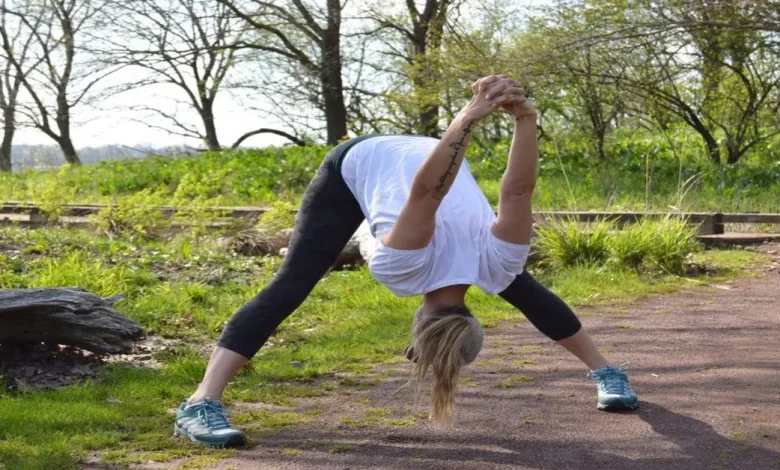
The standing forward fold, done with generously bent knees, addresses all of this at once. Stand with feet hip-width apart, bend your knees significantly more than you think you need to and fold forward, letting your torso hang heavy. Let your head drop. Release your neck. You might hold opposite elbows and let the weight of your arms pull your upper body down further. Breathe into your lower back and feel the space opening between each vertebra.
The bent knees are important. A straight-leg forward fold prioritizes hamstring stretch and often creates tension in the lower back for people who are already tight. Bent knees take the hamstrings out of the equation and allow the spine to decompress fully. As you hold the pose again, aim for ninety seconds to two minutes you can slowly begin to straighten the legs if your hamstrings permit, but there’s no obligation to. The decompression is the goal, not the aesthetics.
Making This a Practice, Not a Checklist
The temptation with a list like this is to treat it as a box to check. Five poses, done quickly after a hike, obligation fulfilled. That approach will produce some benefit, but not nearly as much as integrating these movements into a genuine practice doing them on non-hiking days, holding them long enough to create real tissue change, paying attention to what each one reveals about your body’s particular patterns and asymmetries.
Hikers who add yoga to their routine often report something they didn’t expect: they become more present on the trail. The proprioceptive training the balance work, the single-leg stability, the slow attention to how the body organizes itself in space carries over directly to how they move over rocks and roots. They feel the ground more accurately. They make better micro-decisions. They recover faster.
The trail will always be unpredictable. That’s the whole point of going. But the body you bring to it can be more prepared than you think not just stronger, but more articulate, more responsive, more at ease with the instability that makes wild terrain worth seeking out in the first place.