Why the Sky Hits Different When There Are No Streetlights
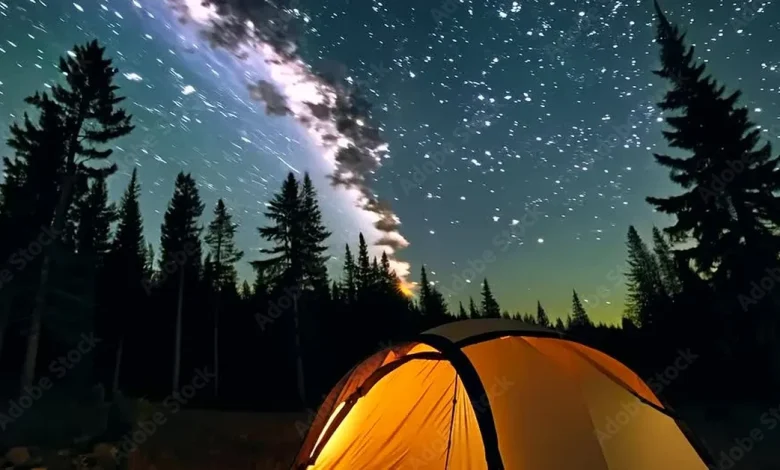
There’s a particular kind of silence that only happens deep in the backcountry the kind where the absence of engine noise and ambient light becomes almost physical. You zip open your tent at two in the morning, maybe to answer nature’s call, and then you just stop. Because the sky above you is doing something the sky over your neighborhood has never done. It’s crowded. Overwhelmingly, impossibly crowded with light.
Most people who camp for the first time in truly dark wilderness report a version of this moment a sudden vertigo, as if the universe has expanded and they’ve shrunk. That feeling isn’t poetic exaggeration. Under a Bortle Class 1 or 2 sky, the human eye can detect somewhere between 2,500 and 5,000 individual stars. The Milky Way doesn’t just appear as a faint smear; it casts a shadow. It has texture. And without any frame of reference, it’s completely disorienting.
That’s where constellation literacy becomes genuinely useful not as a trivia pursuit, but as a cognitive anchor. Learning to read the sky is learning to feel at home in the dark.
Start With What You Already Know (Even If You Think You Know Nothing)
Almost everyone has seen Orion, even from a city. Those three stars in a tight diagonal line Alnitak, Alnilam, Mintaka form the belt, and they’re the entry point for almost every backcountry stargazer. Orion is a winter constellation in the Northern Hemisphere, dominating the southern sky from November through March. If you’re camping in that window, find the belt first. Then let your eyes travel upward to Betelgeuse, a distinctly reddish-orange star marking the hunter’s right shoulder, and downward to Rigel, a blue-white giant at the opposite corner. These two stars alone tell you something real: color in stars isn’t accidental. It’s temperature. Betelgeuse is a red supergiant burning cooler, running out of time on a cosmic scale. Rigel burns hotter, younger in stellar terms, bluer.
Once you have Orion, the sky opens up like a map that’s been folded the wrong way for years. Follow the belt stars southeast and you’ll arrive at Sirius, the brightest star in the entire night sky part of Canis Major, the big dog trailing the hunter. Follow the belt northwest and you’ll reach Aldebaran, the red eye of Taurus, and just beyond it, the tight little cluster of the Pleiades, which ancient cultures on nearly every continent named and told stories about independently.
That’s the real trick to learning constellations: don’t try to memorize them in isolation. Learn them in relationship to each other. The sky is a network, not a collection.
The Circumpolar Stars: Your All-Season Navigation System
Orion disappears in summer. But some stars never set below the horizon if you’re in the Northern Hemisphere they circle Polaris, the North Star, in endless loops. These are the circumpolar constellations, and for backcountry campers, they’re the ones worth knowing cold.
Polaris itself is not the brightest star in the sky, which surprises most people. It sits at roughly magnitude 2, visible but not dominant. What makes it extraordinary is its position: almost exactly above Earth’s rotational axis. It doesn’t move. Every other star in the sky traces an arc around it over the course of a night. Point yourself at Polaris and you’re pointing north with an accuracy that would have made medieval navigators weep with gratitude.
Finding Polaris requires finding the Big Dipper first, which isn’t technically a constellation but an asterism a recognizable pattern within the larger constellation Ursa Major. The two stars forming the outer edge of the Dipper’s bowl (Dubhe and Merak) point directly to Polaris when you extend a line from Merak through Dubhe and continue roughly five times that distance. Once you’ve done this a few times, it becomes automatic, like finding the light switch in a dark room you know well.
On the opposite side of Polaris from the Big Dipper, you’ll find Cassiopeia five stars arranged in a clear W or M shape depending on its position in its nightly rotation. Cassiopeia is particularly useful when the Big Dipper dips low toward the horizon and becomes harder to read. Between the two of them, you always have a path to north.
Summer Skies and the Triangle That Defines Them
Come June, the geometry of the sky shifts entirely. Orion is gone. What takes over is a different kind of drama softer, more expansive, the Milky Way now arcing directly overhead rather than sitting low on the horizon.
The Summer Triangle is the first thing to find. It’s not a constellation either, but an asterism formed by three stars from three separate constellations: Vega (the brightest, in Lyra), Deneb (in Cygnus), and Altair (in Aquila). On a clear summer night, the Triangle sits almost directly overhead around midnight, and the Milky Way runs straight through it. Deneb is worth a moment of contemplation it appears dimmer than Vega despite being one of the most luminous stars in the entire galaxy. The reason is distance. Vega is about 25 light-years away. Deneb is somewhere between 1,400 and 2,600 light-years out, depending on the measurement. You are looking at something almost incomprehensibly far away.
From Cygnus, you can trace the Northern Cross a more obvious shape to many people than the Swan it’s supposed to represent. The long axis of the cross runs along the spine of the Milky Way, making it a useful marker for finding the galactic center’s direction on a summer night.
Reading the Sky Without an App
There’s a quiet argument happening in the outdoor community about phones and star apps. Tools like SkySafari or Stellarium are genuinely excellent they use your GPS and compass to overlay constellation lines on a live view of the sky, and there’s nothing wrong with using them. But there’s a different quality of knowledge that comes from learning to read the sky without assistance, the same way there’s a difference between navigating with a map you’ve studied and navigating with turn-by-turn directions.
One practical method: before your trip, spend fifteen minutes looking at a seasonal star chart for your latitude. Not an app a printed or PDF chart, the kind that shows you the whole sky at once. Note where the key constellations rise and set, which direction they’re in at midnight, and how they relate to each other. Then when you’re in the field, you’re not decoding the sky from scratch. You’re recognizing something you’ve already partially learned.
The other thing worth developing is a sense of time-keeping by stars. The sky rotates approximately 15 degrees per hour. Polaris doesn’t move, but the Big Dipper swings around it. If you know roughly where the Dipper is at sunset, you can estimate the time in the middle of the night by how far it’s rotated not with clock precision, but with enough accuracy to know whether it’s midnight or three in the morning. Before mechanical clocks, this was simply how humans told time in the dark.
The Planets Are Not Stars (And They’ll Confuse You If You’re Not Ready)
One thing that trips up new backcountry stargazers consistently: planets. Mars, Jupiter, Saturn, and Venus are often the brightest objects in the sky outside of the Moon, and they don’t appear on static star charts because they move. Jupiter can blaze so brightly it looks like a landing aircraft. Mars, during opposition, turns a vivid orange-red that makes Betelgeuse look pale.
The rule of thumb is this: stars twinkle, planets don’t. The twinkling effect technically called scintillation happens because stars are point sources of light so distant that Earth’s atmosphere disrupts their light beam. Planets, being close enough to show a tiny disk even though you can’t see it with the naked eye, have enough angular size that the atmospheric disruption averages out. If something is very bright and steady, it’s almost certainly a planet.
Once you accept that planets are guests moving through the fixed star patterns, they become interesting rather than confusing. Watching Jupiter drift slowly through a constellation over the course of a camping season or even a single week-long trip gives you a visceral sense of the solar system’s mechanics that no diagram can fully replicate.
What the Old Stories Were Actually Doing
Every culture that lived under dark skies built stories around them, and it’s tempting to dismiss this as mythology in the pejorative sense fantasy, decoration. But the mythological layer served a real function. Narrative is how human memory works at scale. The Greeks didn’t tell stories about Scorpius chasing Orion across the sky because they were fanciful; they told that story because it encodes something true and useful: Scorpius rises in the east as Orion sets in the west. They are never in the sky at the same time. If you know the myth, you know the astronomy.
The Aboriginal Australians developed an entirely different approach rather than connecting dots into figures, they read the dark patches in the Milky Way as shapes: the Emu in the Sky, whose head is the Coalsack Nebula near the Southern Cross. This negative-space astronomy tracked the emu’s breeding season with remarkable precision, because the Emu’s position in the sky correlated with the time of year when emus lay eggs on the ground.
Different cognitive architecture, same underlying project: using the sky as a clock, a calendar, and a compass all at once.
There’s something in that worth sitting with, the next time you’re lying on your sleeping pad at some unreasonable hour, watching a satellite drift silently across the band of the Milky Way. All of that the navigation, the timekeeping, the seasonal awareness, the sheer orientation in space is available to you, for free, every clear night you spend away from artificial light. You just have to learn to look.