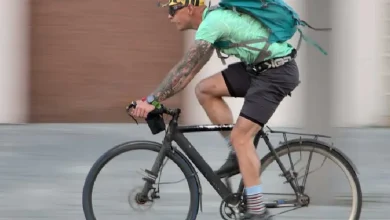
There’s a particular kind of stiffness that every serious cyclist knows. It settles in after a long ride not the satisfying muscle soreness of a hard effort, but something deeper and more stubborn. A tightness that lives in the hips, the groin, the low back. You stretch a little, maybe roll around on the floor for a few minutes, and call it good. But the next morning, you’re still walking like someone twice your age.
This isn’t a coincidence. Cycling is a sport built on repetition the same circular motion, thousands of times per hour, with your hips locked in a narrow range of flexion. The hip flexors shorten. The glutes disengage. The piriformis grips. Over weeks and months, the body adapts to the position you hold most often, and the position you hold most often on a bike is one that human anatomy was never particularly designed for.
Yoga doesn’t fix this overnight. But it does something that foam rollers and static stretches often can’t it asks the body to move through tension rather than simply push against it. For cyclists, that distinction matters more than most people realize.
Why Your Hips Take the Worst of It
The hip joint is a ball-and-socket joint capable of an impressive range of movement: flexion, extension, internal and external rotation, abduction, adduction. On a bike, you use approximately one of those. Hip flexion. Over and over, in a range that rarely exceeds 90 degrees.
What happens to a joint that only ever moves in one direction? The muscles that create that movement primarily the iliopsoas and the rectus femoris become chronically shortened. The muscles on the opposing side, the glutes and hip extensors, gradually stop firing with full force because they’re never asked to fully lengthen. Meanwhile, the smaller stabilizing muscles, like the piriformis and the TFL, compensate by gripping harder than they should. The result is a hip complex that feels simultaneously tight and weak. Tight where it should be mobile, weak where it should be strong.
This imbalance doesn’t stay in the hips. It radiates. Tight hip flexors pull the pelvis into anterior tilt, which compresses the lumbar spine. Weak glutes shift load onto the IT band and the knee. What starts as hip tightness ends up as back pain, knee pain, and a power output that plateaus despite increasing training volume.
Yoga, practiced consistently, begins to unravel this pattern not through aggressive stretching, but through a combination of lengthening, strengthening, and body awareness that most cyclists never develop on the bike.
Low Lunge (Anjaneyasana)
Start here. This is the pose that directly targets the iliopsoas the deep hip flexor that does more work on a bike than almost any other muscle and gets almost no relief afterward.
From a standing position, step one foot back into a long lunge, lowering the back knee to the ground. The front knee stacks over the ankle. Now, instead of simply sinking into the stretch, think about pressing the back knee into the floor and drawing the front foot gently backward you won’t move, but the muscular engagement changes everything. The hip flexor of the back leg begins to release under load rather than under passive pressure.
Hold for eight to ten slow breaths. Lift the arms overhead if you want to deepen the spinal extension. Notice how the sensation shifts as you breathe yoga is largely about learning to stay present with discomfort rather than reacting to it, and that patience is exactly what tight hip flexors need.
Pigeon Pose (Eka Pada Rajakapotasana)
Few poses are more immediately humbling for cyclists than pigeon. The external rotation it demands is precisely what gets locked out by hours in the saddle, and the piriformis that small, deep muscle that cyclists tend to compress against a saddle for hours at a time has nowhere to hide.
From a tabletop position, bring one knee forward and place it behind the same-side wrist. Extend the opposite leg straight back. Lower the hips toward the floor. If the hips don’t reach the ground evenly, place a folded blanket or block under the hip of the bent leg. This isn’t cheating it’s how you actually access the stretch rather than just collapsing into a twisted version of it.
Stay here for at least ninety seconds per side. The first thirty seconds will feel intense. The second thirty, the nervous system begins to accept the position. By the final thirty, you might feel a genuine release a softening that passive stretching alone rarely produces. That’s the piriformis letting go.
Reclined Figure-Four (Supta Kapotasana)
For cyclists who find pigeon too intense, or who are working through existing hip or knee discomfort, this supine variation delivers much of the same benefit with significantly less strain on the joint.
Lie on your back with both knees bent, feet flat. Cross one ankle over the opposite thigh, flexing the foot to protect the knee. Either stay here or draw both legs toward your chest, holding the back of the thigh. The sensation should land in the outer hip and glute of the crossed leg.
What makes this pose particularly useful is its accessibility. You can do it on a yoga mat, on a hotel room floor, or on the carpet next to your bike trainer. The barrier to entry is low, which means it’s more likely to actually happen and consistency matters infinitely more than intensity when it comes to releasing chronically tight tissue.
Bound Angle Pose (Baddha Konasana)
Cycling creates a strong bias toward the sagittal plane forward and back. Bound angle works in the frontal plane, targeting the inner thighs and groin, which are often overlooked but contribute significantly to hip restriction.
Sit on the floor and bring the soles of the feet together, letting the knees fall open to the sides. Hold the feet and sit tall. Don’t force the knees toward the floor instead, think about lengthening the spine upward, which naturally allows the hips to open. If the low back rounds severely, sit on a folded blanket to tilt the pelvis slightly forward.
This pose also has a quieting effect on the nervous system. After a hard ride, when the body is still buzzing with adrenaline and cortisol, sitting in bound angle for five minutes does something that a cold shower can’t. It signals the body that the effort is over. Recovery is not just physical it’s neurological, and poses like this one help bridge that transition.
Legs Up the Wall (Viparita Karani)
This one looks almost too simple to be useful. It isn’t.
Sit sideways against a wall, then swing your legs up as you lower your back to the floor. Let the legs rest against the wall, heels pointing toward the ceiling. Arms rest at your sides, palms up. Close your eyes.
For cyclists, the benefits are layered. The mild inversion encourages venous return from the legs, reducing the heavy, pooled feeling that lingers after long rides. The passive hip flexion at roughly 90 degrees the exact position you hold on the bike is now held without muscular effort, allowing the hip flexors to lengthen passively over time. And the complete absence of demand on the body creates a recovery environment that active stretching simply cannot replicate.
Stay for five to ten minutes. Most cyclists find this harder than any of the other poses not physically, but mentally. Doing nothing feels unproductive. But this is the practice: learning that rest is not the absence of training. It’s part of it.
Making It Stick
The honest truth about yoga for cyclists is that a single session does very little. The hip flexors didn’t get tight in one ride, and they won’t release in one practice. What changes things is the accumulation ten minutes after every ride, a longer session once a week, a genuine commitment to treating mobility as training rather than as an afterthought.
Cyclists are, by nature, disciplined people. They track watts and heart rate and cadence with meticulous precision. That same rigor, applied to a consistent yoga practice, produces results that show up not just on the mat but on the bike in a more powerful pedal stroke, a more comfortable position in the saddle, and a body that recovers faster than it used to.
The hips are where the ride lives. Take care of them, and they’ll take care of you for a long time to come.