It rained for eleven straight hours somewhere outside Asheville, North Carolina, and I spent every single one of them lying in a puddle.
Not a dramatic puddle. Not a cinematic, “I survived the wilderness” kind of puddle. Just a slow, cold, miserable seep of water that worked its way under my tent floor, soaked through my sleeping pad, and made me question every life choice that had led me to that moment. I’d spent $340 on that tent. I’d watched three YouTube reviews before buying it. And there I was, wet, angry, and wide awake at 3 a.m., listening to my camping buddy Dave snore from inside his hammock like he was in a Tempur-Pedic commercial.
That was the last night I ever slept in a tent on a backpacking trip.
The Tent Was Never as Good as I Thought It Was
Here’s the thing nobody tells you when you’re standing in REI comparing tent footprints: a tent is only as good as the ground underneath it. And the ground is almost never good. It’s sloped, or rocky, or wet, or all three at once. You spend twenty minutes trying to find a “flat” spot, convince yourself it’s flat enough, and then spend the whole night slowly sliding toward one corner of your sleeping bag.
Hammock camping removes that variable entirely. Completely. The ground becomes irrelevant which, once you’ve experienced it, feels almost like cheating.
But I’m getting ahead of myself.
What Actually Happens When You Switch to Hammock Camping
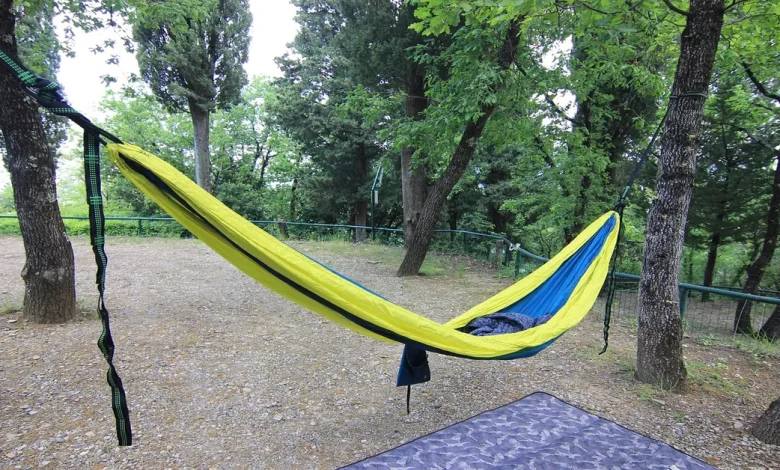
The first time I slept in a hammock overnight a Kammock Roo I borrowed from Dave after the Asheville disaster I didn’t sleep great. I’ll be honest about that. I woke up a couple times, felt slightly cold on my back, and had to figure out my diagonal lay angle through a lot of trial and error. Anyone who tells you the transition is seamless is either lying or a very unusual sleeper.
But here’s what I noticed by morning: I wasn’t sore. At all.
I’m a side sleeper who has spent years waking up with a stiff lower back after tent camping. That first hammock morning, I sat up or rather, rolled out and felt genuinely rested. That was enough to make me take it seriously.
The cold back issue, by the way, is real and it’s the most common reason people give up on hammocks too early. You need an underquilt. Not a sleeping pad shoved underneath you an actual underquilt that wraps around the outside of the hammock and insulates you from below. Once I added a Hammock Gear Incubator underquilt to my setup, the cold back problem disappeared completely. That piece of gear changed everything.
The Weight Argument Is More Complicated Than You Think
People love to say hammocks are lighter than tents. Sometimes that’s true. Sometimes it’s not and I think the hammock community does itself a disservice by oversimplifying this.
A quality hammock plus suspension system plus underquilt plus a tarp for rain protection? You’re looking at a real weight that can rival a decent ultralight tent if you’re not careful about what you buy. The difference is that with a hammock, every single component is doing a specific job, and there’s no dead weight. A tent always has some dead weight poles, a footprint, a vestibule you use twice a season.
My current hammock setup a Warbonnet Blackbird, Dutchware hardware, a Hammock Gear underquilt, and a cheap silnylon tarp comes in around 2.8 lbs total. My old three-season tent was 4.2 lbs without the footprint. So yes, I’m saving weight. But the bigger win isn’t the number on the scale.
The Setup Speed Nobody Talks About
The real advantage and this one genuinely surprised me is how fast camp setup becomes.
Find two trees the right distance apart. That’s basically the whole job. Hang the hammock, hang the tarp, clip on the underquilt. I’m done in under eight minutes. My old tent routine involved staking out a footprint, assembling poles, threading them through sleeves, adjusting tension, and then realizing I’d put the door facing the wrong direction. Every. Single. Time.
There’s also something deeply satisfying about being off the ground. I know that sounds abstract maybe even a little woo-woo but hear me out. You’re not disturbing the ground cover. You’re not compressing vegetation. You’re just borrowing two trees for a night and leaving no real trace. For someone who cares about the places they camp in, that matters.
When Hammock Camping Actually Doesn’t Work
Look, I’m not going to pretend hammocks are the answer to every camping situation. That would be exactly the kind of one-sided enthusiasm that made me distrust the hammock evangelists in the first place.
Above treeline? You’re out of luck. Alpine environments, desert camping, open meadows anywhere without two healthy trees in the right configuration, a hammock is dead weight. I carry a bivy and a small tarp for those situations. Some people switch back to a tent for those trips. That’s a completely reasonable call.
And if you’re camping with young kids? The logistics get complicated fast. A tent is genuinely easier when you’re managing little people who need to be in the same enclosed space as you.
But for most three-season backpacking in forested terrain which is honestly where I do ninety percent of my camping the hammock wins every time.
The One Thing I Wish Someone Had Told Me Earlier
Spend the money on the underquilt first. Before you upgrade your hammock. Before you buy fancy suspension hardware. The underquilt is the single component that determines whether hammock camping is a revelation or a miserable experiment.
I wasted one full season using a sleeping pad stuffed underneath me, wondering why I kept waking up cold. The pad shifts. It doesn’t conform to the hammock’s curve. It’s a workaround, not a solution.
Get the underquilt. Everything else is details.
So Why Don’t More People Make the Switch?
Honestly? I think it’s the learning curve not the physical difficulty, but the mental model shift. We’ve been told our whole camping lives that a tent is the shelter. It’s the default. It’s what you picture when someone says “camping gear.”
Letting go of that default is harder than it sounds, even when the evidence is right there even when you’re lying in a puddle at 3 a.m. while your friend snores peacefully six feet off the ground.
Is a hammock right for every camper? No. Probably not. But if you’re a forest camper who keeps waking up sore, keeps fighting with rocky ground, and keeps telling yourself your tent is “good enough” maybe ask yourself what you’re actually holding onto.
Because Dave’s been trying to tell me for three years, and I didn’t listen until I was wet enough to care.