The Moment Nobody Warns You About
You park the car, grab your pack, and walk until the trailhead sign disappears behind the tree line. Then you keep walking, because that’s what you came here to do. The first twenty minutes feel like a commute with better scenery. Your brain is still running on city time composing emails, replaying conversations, doing that thing where it rehearses arguments with people who aren’t even there.
And then, somewhere around the forty-minute mark, your legs get tired enough that you stop.
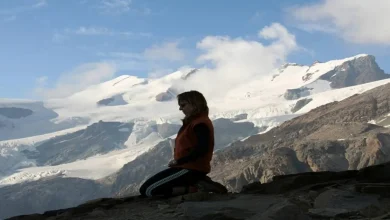
Not a planned stop. Not a water break you penciled into some hiking app. Just you stop. You sit on a log or a rock or the ground itself, and for a second you feel almost guilty about it, like you’re not getting enough out of the experience unless you’re moving through it.
That guilt is worth paying attention to.
Why Stillness in the Forest Feels Wrong at First
Most people who talk about forest bathing or nature therapy, or whatever the current label is describe it as a gentle, obvious thing. Step outside. Breathe deep. Feel better. And look, I don’t want to be the person who argues against trees. But that framing skips the uncomfortable part, which is that the first ten to fifteen minutes of genuine stillness in a forest feel deeply weird if you’re not used to it.
I found this out the hard way. A few years back, I spent a weekend at a cabin near Asheville with my friend Marcus no agenda, no trail map, just some vague intention to “disconnect.” The first afternoon, I sat outside on the porch for what I thought was a long time. Checked my phone. It had been four minutes. I felt restless, then bored, then almost anxious, like I was forgetting something important. I went inside and reorganized my bag.
That was not the nature experience I’d been sold.
What nobody told me is that your nervous system has to go through a kind of withdrawal before it can actually settle. The forest isn’t doing anything wrong. You’re just still vibrating at the wrong frequency.
What You Actually Start Hearing
Here’s the part that sounds a little strange until it happens to you.
When you stop moving really stop, not just slow down the forest doesn’t get quieter. It gets louder. Or more accurately, it gets fuller. A woodpecker you didn’t notice before. The specific way wind moves through pine needles versus oak leaves they genuinely sound different, and once you hear it you can’t unhear it. Water somewhere you can’t see. The small, dry crackle of something moving through underbrush about thirty feet to your left.
Your brain starts doing something it almost never gets to do in ordinary life: it processes sound without immediately assigning urgency to it. That rustling isn’t a deadline. That bird call isn’t a notification. Your threat-detection system slowly, reluctantly, takes a break.
But here’s the thing I want to push back on a little this isn’t magic. It’s not mystical. It’s closer to what happens when you give an overworked muscle time to stop contracting. The forest isn’t healing you. Your own nervous system is finally getting out of its own way.
The Stillness Practice Most People Get Backwards
There’s a version of this that gets popular every few years, where someone writes a piece about sitting in nature for an hour and having some kind of revelation, and then everyone tries to replicate the revelation instead of the sitting.
That’s the wrong order.
You don’t go into the forest looking for something. You go in, you stop moving, and then you wait to find out what’s actually there. The distinction sounds small. It isn’t.
I’ve tried both approaches and I’ll be honest, the “seeking” version mostly produced a low-grade disappointment, like watching a movie you’d been overhyped about. The waiting version, though even on days when nothing dramatic happened left me feeling like I’d actually been somewhere. Not just passed through it.
How Long Does It Actually Take?
Genuinely, it depends. I know that’s not satisfying, but I’d rather say it than make up a clean number.
For most people who are coming off a high-stress week, you’re probably looking at thirty to forty minutes before the mental noise starts to drop to a level where you can hear past it. Some people need longer. Some people and I was not one of them, for what it’s worth can settle in faster if they’ve built the habit over time.
The research on this is interesting, though not as clean as the headlines make it sound. Studies on forest bathing often measure cortisol levels or blood pressure, and yes, those numbers tend to move in favorable directions. But the studies that impress me most are the ones looking at what happens to attention after time in nature specifically, the kind of attention that lets you focus without forcing it. That’s the thing that actually changes when you stop moving long enough.
One Counterintuitive Thing Worth Sitting With
Here’s the part where I’ll probably lose some people.
I think the forest is most useful not as an escape from your life, but as a place to think about it more clearly. Which sounds like I’m just repackaging productivity culture with pine trees, but that’s not what I mean.
What I mean is: the problems you were avoiding don’t disappear when you go quiet. They surface. And the forest because it doesn’t respond to you, doesn’t need anything from you, doesn’t have an opinion is one of the few places where you can actually look at those problems without immediately having to perform a reaction to them.
That’s rarer than it sounds.
What to Do With the Silence Once You Find It
Nothing. That’s the answer, and it’s the hardest one.
Don’t journal. Don’t plan your next move. Don’t try to memorize the experience so you can describe it later that’s just a more sophisticated form of not being there.
Just let the woodpecker be a woodpecker. Let the wind through the pines be exactly that. Let the thing moving in the underbrush stay mysterious.
You came out here because something in you knew it needed a rest from meaning-making. So give it one.
The forest has been doing this a lot longer than you have making sound, holding still, existing without any particular agenda. You don’t have to figure it out. You just have to stop moving long enough to be in it.
And if you feel restless at first? That’s not a sign you’re doing it wrong.
That’s just the sound of your old frequency finally starting to fade.