The World Before It Wakes
There’s a particular quality to the air at six in the morning that most people never experience. Not because they lack curiosity, but because the alarm goes off and the pull of the pillow wins. Those who do roll out, clip in, and push away from the curb enter something that can only be described as a borrowed hour a stretch of time that belongs to no one yet, where the city or the countryside exists in a half-formed state, still exhaling the last of the night.
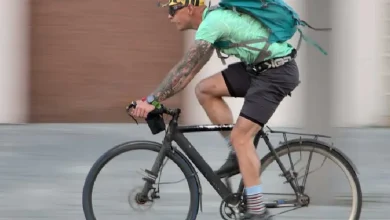
On a solo ride at that hour, you are the only moving thing for long stretches. The traffic lights cycle through their colors for an empty intersection. A dog watches you from a porch without barking. The road ahead is yours in a way it will never be at noon.
This isn’t just pleasant. It’s psychologically significant.
Motion as a Gateway to Stillness
There’s a contradiction at the heart of cycling that takes time to understand. You are moving sometimes fast, legs turning, lungs working, the mechanical hum of a well-tuned drivetrain beneath you and yet the mental state you arrive at is one of profound quiet. Neuroscientists would point to the rhythmic, bilateral nature of pedaling as a partial explanation. The repetitive physical motion engages the body just enough to quiet the parts of the brain responsible for rumination, the same regions that light up when you’re lying awake at 2 AM replaying a conversation you had three weeks ago.
But science only gets you so far. The experience itself is harder to categorize.
Ask anyone who rides regularly in the early morning and they’ll struggle to explain it without reaching for language that sounds almost spiritual. “It’s the only time my head is clear.” “I solve problems I didn’t know I had.” “I come back a different person.” These aren’t exaggerations. They’re attempts to describe a mental state that doesn’t have a clean English word something adjacent to flow, adjacent to meditation, but with wind in it.
Why Solo Matters
Group rides have their own rewards. The camaraderie, the shared suffering on a climb, the way a paceline can feel like a single organism moving through space. But group rides also come with social cognition running in the background. You’re tracking pace, reading body language, managing the subtle politics of who pulls and for how long. Part of your mind is always occupied with other people.
Solo is different. Solo is exposure.
When there’s no one to talk to, no wheel to follow, no one watching your cadence or your form, you’re left alone with the quality of your own thinking. For some people, this is uncomfortable at first. The silence has texture. Old anxieties surface. The mind, deprived of external stimulus, turns inward and doesn’t always find pleasant things waiting there.
But this is precisely the point. The early morning solo ride functions as a kind of forced reckoning not in a punishing way, but in the way that sitting quietly after a long period of noise eventually reveals what was underneath all along. You process. You untangle. You arrive at the end of a two-hour ride having worked through something you didn’t consciously set out to work through.
The Particular Alchemy of 6 AM
Timing matters more than most cyclists admit. A solo ride at noon on a Saturday is a fine thing. But it doesn’t carry the same charge. The morning hour has a specific psychological weight that comes from its position in the day before obligation, before the inbox, before anyone has made a demand of you.
There’s also something about being awake before the world that creates a quiet sense of agency. You chose this. You got up when you didn’t have to. That small act of self-determination colors the entire ride. You’re not escaping anything; you’re arriving somewhere. The distinction is subtle but real, and you can feel it in the quality of the thoughts that come.
Writers and artists have long known this. Toni Morrison wrote before dawn because the early morning felt “mine.” Haruki Murakami runs at four or five in the morning as part of a discipline he describes as almost monastic. The cyclist at 6 AM is in the same tradition not because cycling is art, but because the early morning hours share a common property: they are uncontaminated by the day’s accumulating noise.
What the Body Teaches the Mind
There’s a specific moment on a long solo morning ride, usually somewhere in the second hour, when the body and mind reach a kind of agreement. The legs have found their rhythm. The initial stiffness has worked itself out. Breathing is no longer something you’re managing it’s just happening. And in that physical ease, something opens up mentally.
This is when the thinking changes quality. It becomes less reactive and more generative. You’re no longer processing yesterday; you’re imagining forward. Ideas arrive without being summoned. Clarity shows up unannounced. It’s the kind of thinking that’s nearly impossible to force at a desk, but seems to emerge naturally when the body is occupied and the environment is moving past at a steady pace.
Athletes call this the second wind. Meditators might call it settling. Whatever the label, the experience points to something important about how human cognition actually works not in the static, seated, staring-at-a-screen way we’ve organized most of modern life, but in motion, in rhythm, in the open air.
The Return
Coming back is its own thing. You turn onto your street, slow down, unclip. The neighborhood is awake now. Cars are moving. Someone is walking a dog. The world has caught up to you.
But you’re carrying something from the other side of that hour that the rest of the day can’t quite touch. Not a solution, necessarily. Not a revelation. More like a recalibration a quiet confidence in your own ability to be alone with yourself without flinching. The ride gave you that. The solitude gave you that. The six o’clock darkness that slowly became light gave you that.
There’s a reason people who ride in the early morning are almost evangelical about it, and also almost unable to fully explain it to someone who hasn’t tried. The experience resists summary. It lives in the body, in the specific memory of cold air and empty roads and the sound of your own breathing.
You just have to go. Once. Before the world wakes up.