The Tent You Bought Was Sold to You by Fear
There’s a particular kind of guilt that settles in around mile eight. Your shoulders are burning, your hip flexors are sending you polite but firm complaints, and somewhere in the back of your pack buried under your sleeping bag, your bear canister, and three days of food is a tent that weighs four and a half pounds. You told yourself it was worth it. The salesperson at the outdoor store told you it was worth it. The reviews said it could handle “four-season conditions,” and even though you’ve never once camped in snow, that phrase did something to your brain that logic couldn’t quite undo.
This is how most people end up overpacking shelter. Not through recklessness, but through a very calculated, very well-marketed form of anxiety.
The outdoor gear industry has spent decades perfecting the art of selling you worst-case scenarios. Four-season tents. Double-wall construction rated to negative twenty. Vestibules large enough to park a bicycle. These are genuinely useful products for a specific slice of the camping population that is doing genuinely extreme things in genuinely extreme places. But that slice is much smaller than the marketing suggests, and the rest of us are out here hauling expedition-grade shelters to campgrounds that have bathrooms with hand dryers.
What Your Tent Is Actually Doing on Most Trips
Let’s be honest about the conditions most recreational campers actually encounter. You’re hiking in summer or early fall. You’re in a region with predictable weather patterns. You checked the forecast before you left. The nights might dip into the forties, maybe the upper thirties if you’re pushing into higher elevation. There’s a chance of afternoon thunderstorms, which will pass. There is not a chance of a whiteout blizzard, because you are not in Antarctica.
In those conditions which describe the overwhelming majority of backpacking trips taken by the overwhelming majority of people a four-pound double-wall tent with a full rainfly and a bathtub floor and an aluminum pole system engineered for wind loads you will never experience is doing approximately twenty percent of what it’s capable of. You are paying, in both money and body weight, for eighty percent of a tent you don’t need.
The argument for going lighter isn’t about being a minimalist purist or proving something to yourself on the trail. It’s simpler than that. Carrying less weight means you arrive at camp feeling like a person rather than a casualty. It means the last two miles don’t become a negotiation between your will and your knees. It means you actually enjoy the thing you came out here to do.
The Real Calculus of Shelter Weight
Here’s where people get tripped up: they think about shelter weight in isolation. Four and a half pounds doesn’t sound catastrophic when you’re standing in a gear shop. But your shelter doesn’t exist in isolation it exists alongside everything else in your pack. And when you start adding it all up, the tent is often the single heaviest item you’re carrying, sometimes heavier than your sleeping bag and sleeping pad combined.
Ultralight backpackers figured this out a long time ago. The so-called “big three” shelter, sleep system, pack are where the real weight lives, and they’re also where you have the most options for meaningful reduction. Shaving two ounces off your toothbrush is a psychological exercise. Switching from a four-pound tent to a one-and-a-half-pound tarp or a two-pound single-wall shelter is a transformation.
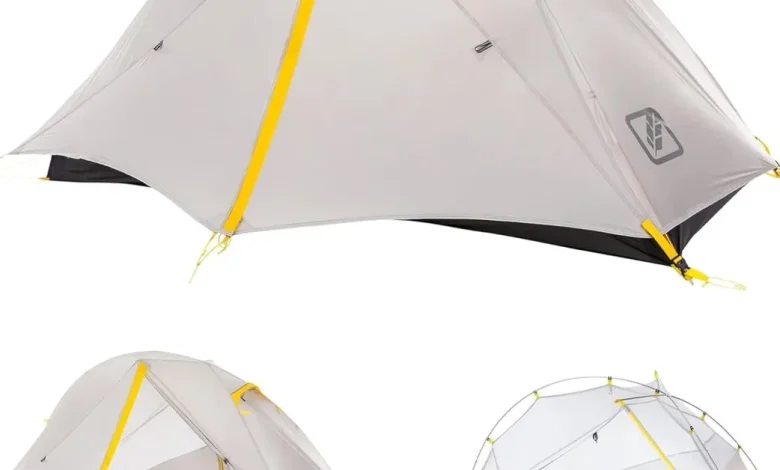
There’s a version of this conversation that immediately conjures images of people sleeping under a garbage bag in a rainstorm, suffering for the sake of a number on a scale. That’s not what this is. Modern ultralight shelters tarps with good ridgeline setups, cuben fiber bivies, well-designed one-person single-wall tents are genuinely capable pieces of gear. They’ve been tested in serious conditions by serious people. The gap between “ultralight” and “compromised” has narrowed considerably over the past decade.
When Your Tent Actually Earns Its Weight
None of this is to say that heavy tents are categorically wrong. Context matters enormously, and there are situations where a robust, four-season shelter is exactly the right tool.
If you’re camping above treeline in shoulder season, where afternoon weather can turn genuinely dangerous and temperatures can swing forty degrees in three hours, you want structure and you want it to hold. If you’re in bug country so severe that a mesh inner is a psychological necessity, a proper tent earns its keep. If you’re car camping, none of this applies at all bring whatever you want, you’re not carrying it anywhere.
The issue isn’t the tent. The issue is the mismatch between the tent and the trip. A surgeon doesn’t bring a full trauma kit to a routine checkup. A chef doesn’t pack a mandoline slicer for a picnic. Tools are designed for specific jobs, and using the wrong tool even a very good wrong tool creates friction that compounds over distance.
The Psychology of Overpacking Shelter
There’s something worth sitting with here, because the tent problem isn’t purely logistical. It’s psychological, and it runs deep.
Shelter is primal. The human nervous system has been tracking “do I have a safe place to sleep tonight” for a very long time, and that tracking doesn’t turn off just because you’re on a recreational trail in a national forest with a well-maintained campsite at the end of it. When you’re choosing gear in the comfort of your home or a brightly lit store, your brain is doing a kind of threat assessment, and it tends to overestimate risk because the cost of overestimating feels lower than the cost of underestimating.
This is why people buy tents rated for conditions they’ll never encounter. Not because they genuinely expect a blizzard in July, but because the possibility of a blizzard in July, however remote, feels more vivid than the certainty of carrying extra weight for six hours. The pain of the blizzard is imaginable and dramatic. The pain of the extra weight is diffuse and boring and easy to discount in advance.
Experienced backpackers learn to recalibrate this. They’ve been out enough times to have a realistic picture of what actually happens versus what might theoretically happen. They’ve also been out enough times to have felt, viscerally, what two extra pounds feels like at the end of a long day. That felt knowledge changes the calculation in a way that no amount of theoretical reasoning can replicate.
A Different Way to Think About It
The question most people ask when choosing a tent is: what’s the worst weather I might encounter? That’s not a bad question, but it’s incomplete. The better question is: what’s the realistic range of conditions I’m likely to face, and what’s the lightest shelter that handles that range comfortably?
Notice the word “comfortably.” This isn’t about suffering through inadequate gear. It’s about right-sizing your kit to your actual adventure, not a hypothetical harder adventure that lives in your imagination.
For three-season hiking in the lower forty-eight, a two-pound single-wall tent or a well-rigged tarp-and-bivy setup handles the realistic range just fine. For shoulder-season trips in exposed terrain, you might bump up to something with more structure and a lower weight ceiling. For true alpine or winter camping, yes, bring the serious tent and probably leave this article behind, because you already know what you’re doing.
The trail has a way of teaching you what you actually need. Every trip where you hauled something heavy and never used it is a data point. Every morning you wake up having slept perfectly well under a shelter that weighs less than your lunch is a data point too.
At some point, all those data points start to feel less like information and more like permission.