The Silence You Didn’t Expect
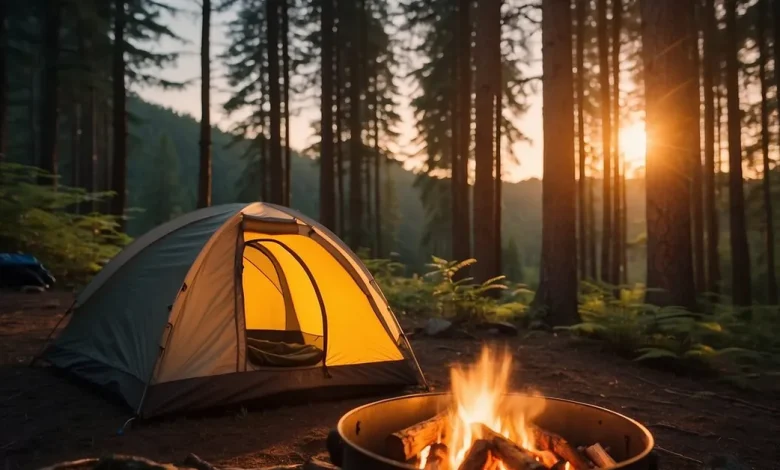
There’s a moment, usually around the second night, when it hits you. Not fear exactly something quieter and more unsettling. You’ve set up camp, eaten your food, filtered your water, done everything right. The fire is low. The trees are still. And then you realize: there is no one to talk to. Not just no one nearby no one who knows precisely where you are, no one waiting for a text, no one to confirm that the sound you just heard was only wind moving through branches.
That moment is the actual beginning of solo wild camping. Everything before it the gear research, the trail maps, the carefully packed bear canister was just preparation for this.
People talk about wild camping as though the primary challenge is physical. Can you navigate? Can you stay warm? Can you purify water and build a fire and read weather patterns? These skills matter enormously, and no one should dismiss them. But experienced solo campers will tell you, often quietly and with some hesitation, that the terrain inside your own head is the harder country to cross.
Why Humans Struggle Alone in the Wild
We are not, neurologically speaking, built for this. Human beings evolved in groups. Our nervous systems were calibrated over hundreds of thousands of years to treat isolation as a threat signal because for most of human history, being alone in the wilderness meant something had gone badly wrong. The tribe was gone. You were separated, lost, vulnerable.
That ancient wiring doesn’t care that you chose this. It doesn’t care that you have a satellite communicator in your pack or that you’ve done this six times before. When darkness falls and the sounds of the forest become unfamiliar, your brain starts running old programs. Hypervigilance kicks in. Small sounds become potential threats. The rational mind knows better; the limbic system is not listening.
This is why so many people who attempt solo wild camping for the first time cut the trip short not because anything went wrong, but because the psychological discomfort became unbearable. They weren’t underprepared in terms of gear. They were underprepared for the experience of being genuinely, completely alone.
The Paradox of Chosen Solitude
Here’s what makes this psychologically interesting: the people who keep going back describe the same discomfort, and they frame it as the point.
There’s a particular type of person drawn to solo wild camping not thrill-seekers in the adrenaline-sport sense, but people who are, in some way, running a diagnostic on themselves. They want to know what they’re like when no one is watching, when there’s no social performance required, when the day’s only agenda is staying alive and staying present. The wilderness becomes a kind of mirror, and the reflection isn’t always comfortable.
A woman who regularly camps alone in the Scottish Highlands once described it this way: the first day, she felt relief. The second day, she felt restless. By the third day, she started having thoughts she’d been avoiding for months about a relationship, about work, about what she actually wanted from her life. The wilderness hadn’t created those thoughts. It had simply removed all the noise she’d been using to drown them out.
This is solitude working as intended. But it requires a certain tolerance for discomfort, and not everyone arrives at that tolerance naturally.
Fear as Information, Not Instruction
One of the more practical mental shifts that experienced solo campers describe is learning to treat fear differently. Fear in the backcountry is data. It tells you to pay attention, to slow down, to assess. What it should not do is make decisions for you.
The distinction sounds simple. In practice, at 2 a.m. with an unfamiliar sound outside your tent, it is not simple at all.
Experienced solo campers develop what might be called a two-track response. One track acknowledges the fear yes, that sound is unusual, yes, your heart rate just spiked, yes, your body is preparing for something. The other track runs a calm assessment: what is the actual probability of danger here? What do you know about this environment? What would you do if something were actually wrong?
Running both tracks simultaneously is a skill. It takes practice. And it’s one of the reasons many solo campers say their trips have made them measurably better at managing anxiety in everyday life. The wilderness is, in a strange way, a controlled environment for learning emotional regulation controlled not because it’s safe, but because the feedback is immediate and honest.
The Weight of Self-Reliance
There’s another dimension to the mental game that gets less attention: the pressure of being your own only resource.
In a group, responsibility is distributed. Someone else can take a turn navigating. Someone else can make the call about whether to push on or make camp early. Someone else can sit with you when you’re not feeling well. Alone, every decision is yours. Every mistake is yours. Every moment of doubt has no external voice to counter it or confirm it.
This can be crushing, especially early on. But it also produces something that’s difficult to manufacture any other way a deep, unambiguous relationship with your own judgment. You make a call, you live with the outcome, you learn. There’s no committee. There’s no one to blame and no one to credit. Just you, the decision, and what happened next.
People who have spent significant time in solo wilderness settings often describe a shift in how they relate to uncertainty. Not that they become reckless, but that they become more comfortable operating without guarantees. They’ve learned, through repeated experience, that they can handle more than they thought. That knowledge doesn’t come from being told you’re capable. It comes from discovering it alone, in the dark, when the alternative was falling apart.
When Survival Becomes Secondary
There’s a threshold that long-distance solo campers sometimes describe crossing, usually several days into a trip, where the mental noise finally settles. The hypervigilance fades. The need for stimulation or distraction dissolves. What’s left is something harder to name a quality of attention that feels different from ordinary wakefulness.
Some people call it presence. Some call it flow. Some don’t call it anything because naming it feels like it would diminish it. You’re watching light move across a ridge. You’re listening to water. You’re not thinking about the past or the future in any active way. You’re just there, in the most literal sense.
This is what the solitude was always moving toward. Not the fear, not the self-examination, not even the competence but this. A particular quality of being alive that, for most people, is almost impossible to access inside the rhythms of ordinary life.
Whether it’s worth the cost of getting there the sleepless nights, the loneliness, the weight of your own unfiltered thoughts is a question only you can answer. But the people who’ve crossed that threshold tend to answer it the same way.
They go back.