Why Rain Changes Everything
There’s a particular kind of helplessness that sets in when you’re soaked through, shivering, and watching your lighter spark uselessly against wet tinder. It’s not just physical discomfort it’s a slow erosion of confidence. Fire is warmth, signal, safety, and morale all compressed into one flickering thing. Lose it, and you lose a lot more than heat.
Rain doesn’t just wet your materials. It saturates the air, raises humidity, and makes ignition feel like an act of defiance against nature itself. But here’s what most people get wrong: rain doesn’t make fire impossible. It just raises the stakes on every decision you make. The gap between success and failure narrows, and the margin for error shrinks dramatically. That’s why starting a fire in wet conditions is less about luck and more about sequencing doing the right things in the right order, with a clear understanding of what you’re actually fighting against.
Understanding the Enemy Before You Fight It
Water kills fire at three points: it prevents ignition, it smothers nascent flame, and it cools burning material below the threshold needed to sustain combustion. Any serious attempt at wet-weather fire-starting has to address all three, not just the first one.
Most people focus entirely on getting a spark or a flame going, then watch it die within seconds because the fuel around it is too wet to catch. The spark was never the problem. The architecture of the fire was.
Think of it this way: fire is a chain reaction. Each burning piece has to produce enough heat to ignite the next piece. Interrupt that chain anywhere with moisture, with poor airflow, with fuel that’s too dense or too sparse and the whole thing collapses. Wet conditions attack every link in that chain simultaneously. So your strategy has to be layered, almost architectural in its thinking.
Finding and Preparing Dry Material
This is where the real work begins, and it starts before you ever strike a match.
Dead wood that’s been lying on the ground is almost certainly waterlogged. Don’t bother with it. Instead, look up. Dead branches that are still attached to standing trees, or that have fallen and become lodged in other branches above the ground, are often dramatically drier than anything on the forest floor. The same logic applies to the underside of fallen logs flip them over and you’ll frequently find dry, workable wood on the side that’s been sheltered from rain and ground moisture.
Birch bark is legendary for a reason. The oils in it resist water absorption, and even in heavy rain, the outer layers can often be peeled back to reveal dry, highly flammable material underneath. Pine resin, pitch pockets in dead pine wood, and fatwood the resin-saturated heartwood of dead pine stumps all carry enough combustible chemistry to burn even when damp. If you find fatwood, treat it like gold.
For tinder, think small and think protected. The inside of a rotting log is often bone dry. Dry grass can sometimes be found sheltered under dense brush or overhanging rocks. Cattail fluff, dried fungi, and the fine inner bark of certain trees can all work. Whatever you gather, keep it close to your body your own warmth and the shelter of your jacket will help dry it slightly while you work.
Building a Structure That Fights Back
Once you have material, the structure of your fire matters more in wet conditions than at any other time.
Start by creating a dry platform. Lay down a base of larger sticks or a piece of bark to keep your tinder off the wet ground. Even a few centimeters of elevation can make a significant difference ground moisture wicks upward through direct contact, and a wet base will drain heat from your fire before it has a chance to establish itself.
Build a small, tight teepee of your finest tinder at the center. Tight enough to hold heat in, but with enough gaps to allow airflow fire needs oxygen as desperately as it needs fuel. Around that, construct a second layer of slightly larger kindling, and then a third of progressively bigger sticks. The idea is to create a self-reinforcing structure where the outer layers are drying out from the heat of the inner layers even as the inner layers are burning.
One technique that experienced wilderness travelers swear by is the “feather stick” a dry piece of wood that you carve with a knife to create thin, curling shavings still attached to the main stick. The shavings offer enormous surface area for ignition while the main stick provides a sustained fuel source. Carving a handful of these from dry inner wood takes ten minutes and dramatically improves your odds.
The Ignition Moment
You’ve built your structure. Now the psychology of the moment matters as much as the technique.
Use your best ignition source first. This isn’t the time to save your waterproof matches or your butane lighter “for later.” Later may never come if you fail here. Apply flame to the base of your tinder structure, not the top. Heat rises, and a flame introduced at the base will climb naturally upward through your materials.
Shield the flame aggressively. Cup your hands, use your body as a windbreak, angle your back against the rain. Even a light drizzle can extinguish a flame in its first critical seconds. Those seconds are everything.
If the tinder catches but the kindling doesn’t follow, resist the urge to blow frantically. Gentle, steady breath directed at the base of the flame is far more effective than panicked puffing. You’re feeding oxygen to the hottest part of the fire, not just agitating the air around it.
Keeping It Alive
Getting a fire started in the rain is one challenge. Keeping it alive is another.
For the first several minutes, treat the fire like something fragile and newborn, because it is. Add fuel slowly and deliberately. Wet wood placed too close to a young fire will steam and cool it; wet wood placed at a slight distance will dry out before it needs to burn. Think of the fire as a slow-moving front, drying and consuming as it goes.
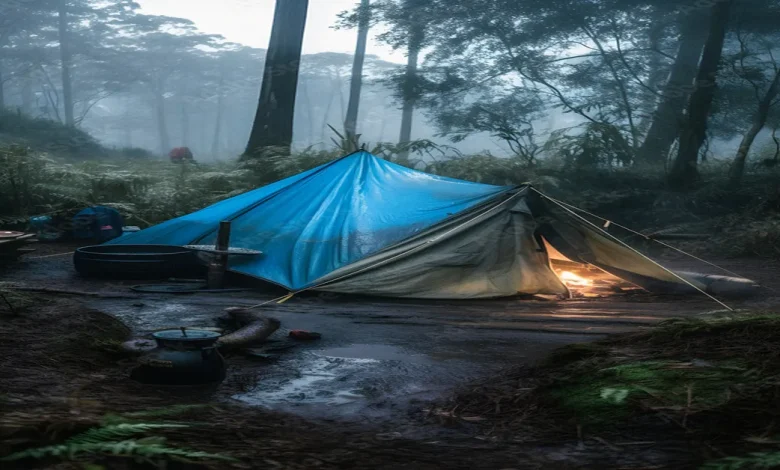
Build a canopy of larger logs above the fire if you can not touching the flame, but positioned to deflect falling rain. Some survivalists carry a small square of aluminum foil or a space blanket specifically for this purpose. It sounds almost too simple, but a rain shield over a young fire can be the difference between success and starting over from scratch.
Once the fire reaches a certain critical mass once you have a genuine bed of coals forming rain becomes far less of a threat. Coals burn at temperatures that rain simply cannot overcome with normal precipitation. The goal of the early stages is to reach that threshold as quickly as possible.
What the Rain Actually Teaches You
There’s something worth sitting with in all of this. Starting a fire in the rain strips away every assumption you’ve ever made about the process. It forces a level of attention and intentionality that dry-weather fire-starting never demands. You can’t be lazy. You can’t skip steps. You can’t rely on good conditions to compensate for poor preparation.
In a strange way, the rain is a better teacher than the sunshine. Every experienced outdoorsperson who has spent real time in the wilderness has a wet-fire story a night when it mattered, when the stakes were real, when the knowledge they’d accumulated either held or failed them. Those stories tend to be told with a particular kind of quiet pride, not because fire is glamorous, but because competence in difficult conditions is one of the more honest forms of confidence a person can carry.
The fire you start in the rain is never the fire you expected to build. It’s smaller, harder-won, and more carefully tended. But it burns just the same.