A Beginner’s Map to Finding the Perfect Stealth Camping Spot
Why Stealth Camping Is Nothing Like What You’ve Seen on YouTube
There’s a version of stealth camping that lives online the one with cinematic drone shots, perfectly filtered tent glows, and narrators who make it all sound like a harmless weekend adventure. Then there’s the real version, which is quieter, more uncertain, and honestly a lot more interesting. If you’re new to this, the first thing worth understanding is that stealth camping isn’t a style. It’s a mindset. You’re not just picking a spot on a map. You’re learning to read land, read people, and read your own risk tolerance in ways that most outdoor activities never ask of you.
The term itself can be misleading. “Stealth” doesn’t necessarily mean illegal or secretive in a sinister sense. It simply means low-profile camping in a way that leaves no trace of your presence and draws no attention. Plenty of experienced long-distance hikers, cyclists, and backpackers do this routinely on public land, forest edges, and rural corridors where formal campgrounds either don’t exist or aren’t practical. The skill lies in knowing the difference between a spot that’s genuinely fine and one that’s going to get you a knock on the tent at 2 a.m.
The Geography of Invisibility
Before you ever look at a map, you need to understand what makes a location genuinely invisible versus what just feels hidden to you. These are not the same thing.
A spot that feels hidden say, a clearing just off a trail might be completely visible to anyone walking that trail at dawn. The way light moves through a forest in the early morning is different from how it moves at dusk. A tent that disappears into shadow at 9 p.m. can become a bright, obvious shape the moment sunlight hits it from a low angle. Experienced stealth campers often scout their spot in the morning before committing to it at night, precisely because the light tells a different story.
The geography you’re looking for has a few consistent features. Elevation change is your friend a site that’s even slightly below the surrounding terrain is far less visible than one on a ridge or a flat open area. Natural screening matters enormously: dense brush, rock formations, or a slight bend in the terrain can make a spot functionally invisible from thirty feet away. Water sources are useful landmarks for finding these kinds of tucked-away areas, since streams and creek beds often carve out small depressions and sheltered zones that don’t appear on standard trail maps.
Distance from access points is the other variable that beginners consistently underestimate. Most casual visitors dog walkers, day hikers, people cutting through on ATVs stay within a quarter mile of wherever they parked. Getting even half a mile off a road or trailhead dramatically reduces the likelihood of encountering anyone at all. This isn’t about paranoia. It’s about understanding traffic patterns, which is essentially what stealth camping navigation comes down to.
Reading Land Ownership Without Getting It Wrong
This is where a lot of beginners get tripped up, and it’s worth slowing down here because the consequences of misreading land ownership range from mildly embarrassing to genuinely serious.
Public land in the United States national forests, Bureau of Land Management territory, state forests generally allows dispersed camping without a permit, though rules vary by specific area and some zones have fire restrictions or designated-use requirements. The key word is dispersed. You’re expected to camp away from water sources, away from trails, and in a way that doesn’t damage vegetation or leave any trace. Apps like Gaia GPS and OnX are useful here, but they’re tools, not authorities. Boundaries shift. Easements exist. A parcel that looks like national forest on a general map might have a private inholding at its center.
Private land is a different matter entirely. Camping on private land without permission is trespassing, full stop. The fact that a field looks empty or a forest looks unused doesn’t change the legal reality. Some stealth campers in rural areas have had success simply knocking on a farmhouse door and asking and the answer is yes more often than you’d expect, especially if you’re polite, specific about your plans, and clearly not going to leave a mess. But that requires a level of social confidence and local knowledge that takes time to develop.
The practical approach for beginners is to stick to clearly identified public land, use multiple mapping sources to verify boundaries, and treat any ambiguity as a reason to move on rather than a reason to rationalize.
The Timing Logic That Most Guides Skip
Arrival and departure timing is one of the most underrated elements of stealth camping, and it rarely gets the attention it deserves in beginner resources.
Arriving late ideally within an hour or two of full dark means fewer people are around to notice you setting up. It also means you’re not sitting in a visible spot for hours before nightfall. The trade-off is that you’re navigating in low light, which requires knowing your route in advance and having your gear organized so you’re not fumbling around with a headlamp for twenty minutes. That light, by the way, is visible from a surprising distance. Red-light mode on a headlamp isn’t just for preserving night vision. It’s also significantly less conspicuous than white light.
Departure timing follows the same logic in reverse. Leaving early before most people are out means you pack up and move without an audience. The goal is to arrive after the world has gone quiet and leave before it wakes up. In between, you’re there, but effectively nowhere.
What You Bring Changes What You Can Do
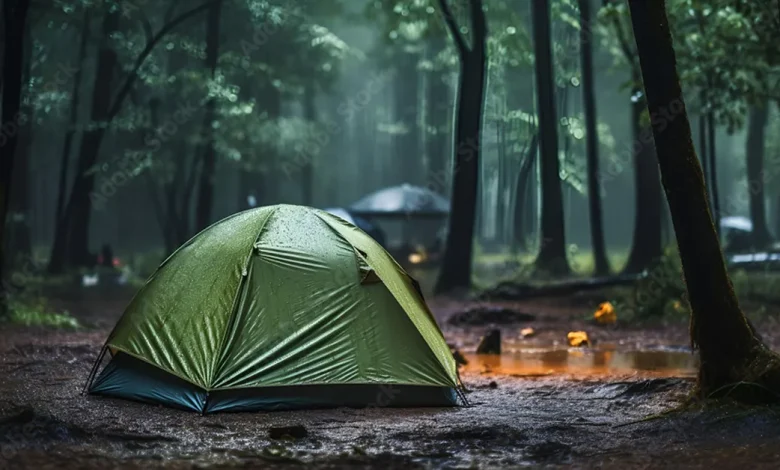
Gear selection for stealth camping isn’t just about weight or weather. It’s about profile. A large, brightly colored tent designed for base camping is going to limit your options significantly. Most experienced stealth campers gravitate toward earth-toned or muted shelters olive, tan, gray that blend into natural backgrounds. Ultralight bivy setups and low-profile tarps are popular not just because they’re lighter, but because they’re genuinely harder to spot.
Noise matters too. A tent with a loud zipper or a sleeping pad that crinkles with every movement isn’t a disaster, but it’s worth thinking about. Sound travels differently at night, and in a quiet rural or forested environment, small sounds carry farther than you’d expect. This isn’t about being anxious. It’s about being thoughtful.
Fire is the variable that changes everything. A campfire is visible for miles and detectable by smell even farther. Most serious stealth campers don’t make fires, or they make very small fires in established fire rings only when the context clearly supports it. A small canister stove with a windscreen is quieter, cleaner, and leaves no trace. It also means you’re not committed to a single spot the way a fire would require.
The Unspoken Skill: Trusting Your Instincts
There’s a moment in every stealth camping trip where you arrive at a spot that looks right on paper but feels wrong in person. Maybe there’s fresh tire track in mud nearby. Maybe the area has a strange amount of litter, suggesting regular foot traffic you didn’t anticipate. Maybe it’s just a feeling you can’t quite articulate.
Learn to trust that feeling. Not because intuition is mystical, but because your brain is processing environmental cues faster than your conscious mind can catalog them. The tire tracks, the litter, the faint sound of something mechanical in the distance these are data points. When a spot feels off, it usually is.
The best stealth campers are patient in a way that beginners often aren’t. They’re willing to walk another twenty minutes, to leave a promising spot because something doesn’t sit right, to arrive at a site and decide in five minutes that it’s not the one. That patience is the real skill. The maps, the gear, the timing those are all learnable. The willingness to keep moving until something genuinely feels right is what separates someone who camps well from someone who just camps.
And when you finally find that spot the one that’s tucked in just right, quiet, invisible, yours for the night there’s a particular kind of satisfaction in it that’s hard to explain to someone who’s never felt it. Not triumph, exactly. Something quieter than that.