There’s a particular kind of confidence that comes from knowing your gear won’t fail you. Not the loud, boastful kind the quiet kind. The kind that lets you move through the woods without that low-level hum of anxiety that follows people who are half-prepared. A lot of that confidence, if you trace it back to its source, comes down to something deceptively simple: knowing how to tie a knot.
Not just any knot. Not the double-loop you’ve been using since you were eight years old, the one that kind of works but always seems to slip at the worst moment. The right knots. Knots that have been tested across centuries of sailing, climbing, hunting, and survival knots that people trusted with their lives long before there were carabiners or zip ties or synthetic webbing.
Most experienced woodsmen will tell you that rope craft is one of those skills that’s embarrassingly easy to neglect. You don’t think about it until you need it. And when you need it, you really need it. A tarp that won’t stay rigged in a rainstorm. A load that shifts on a pack frame. A handline that needs to hold your weight on a muddy descent. These aren’t hypotheticals. They’re the ordinary inconveniences and occasional emergencies that separate a good day in the woods from a miserable one.
Three knots, learned well, will handle the vast majority of what the backcountry throws at you. Not three dozen. Three. The goal isn’t to memorize a rope encyclopedia. It’s to build genuine muscle memory with a small set of tools that you can execute in the dark, in the cold, with numb fingers and a tired mind.
The Bowline: The Knot That Won’t Let You Down
If you could only learn one knot for the rest of your life, most serious woodsmen and sailors would point you toward the bowline. It creates a fixed loop at the end of a rope that won’t slip under load, won’t jam so tight that you can’t untie it afterward, and holds its shape even under significant strain. That combination reliable under tension, easy to release is rarer than you’d think in the world of knots.
The classic memory trick is the rabbit story: the rabbit comes out of the hole, goes around the tree, and goes back down the hole. It sounds childish until you realize you’re still using it at forty years old, at midnight, trying to rig a bear hang in the rain. The story works because it maps the physical motion of the rope in a way that sticks.
What makes the bowline genuinely useful in the woods is its versatility. You can use it to tie off a tarp line to a tree without the loop constricting as weight builds. You can tie a loop around your own waist for a hasty harness in a rescue situation. You can secure a canoe to a dock, anchor a ridgeline, or create an attachment point for almost anything that needs a stable loop. The bowline doesn’t care about the application. It just holds.
One caveat worth knowing: the standard bowline can work loose under intermittent, shock-loaded tension the kind you get when a rope is repeatedly loaded and released rather than held steady. In those situations, a double bowline or a bowline with a stopper knot adds security. But for the vast majority of wilderness applications, the basic bowline is exactly enough.
The Clove Hitch: Fast, Adjustable, and Everywhere
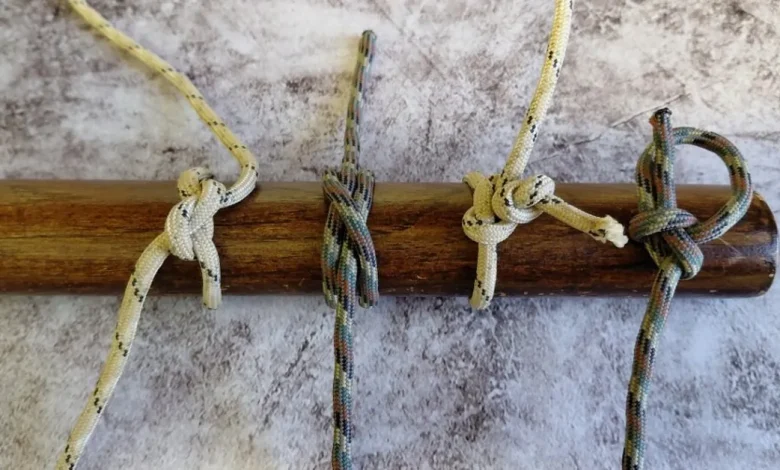
Speed matters in the woods. When a storm rolls in faster than expected and you need to get a tarp up in three minutes, you don’t have time for elaborate rigging. The clove hitch is the answer to that problem. It’s two half hitches crossed over each other, and once you’ve tied it a few hundred times, you can throw one on a post or a tree branch in about four seconds flat.
What sets the clove hitch apart isn’t just speed it’s adjustability. Unlike knots that lock into a fixed position, the clove hitch can be slid along a pole or rope to reposition your attachment point without untying and retying. That’s enormously useful when you’re building a camp shelter and need to fine-tune the angle of a ridgeline, or when you’re lashing gear to a frame and want to shift weight distribution. You loosen it slightly, slide, retighten. Done.
Lashing is where the clove hitch really earns its keep. Any time you’re building a structure from natural materials a lean-to frame, a makeshift stretcher, a camp table from branches you’ll start and finish your lashings with a clove hitch. It locks the wrapping in place and keeps everything from rotating or sliding. Traditional bushcraft skills like square lashing and diagonal lashing both depend on the clove hitch as their anchor.
The honest limitation is that the clove hitch doesn’t perform well under loads that pull from multiple directions or that shift dramatically. It’s not the knot you want for a critical safety line. But as a quick, adjustable, general-purpose hitch for camp construction and rigging? It’s indispensable.
The Trucker’s Hitch: Mechanical Advantage in Your Hands
This one changes how you think about rope entirely. The trucker’s hitch sometimes called the wagon wheel hitch or the lorry driver’s hitch depending on where you learned it creates a simple pulley system using nothing but the rope itself. It lets you apply two to three times the tension you could generate by pulling with your hands alone. That’s not a small thing when you’re trying to get a ridgeline tight enough to shed rain, or lashing a load that absolutely cannot shift.
The mechanics are straightforward once you see them. You form a fixed loop partway along the rope typically a slip knot or a figure-eight on a bight and then pass the working end through an anchor point and back through that loop. Now you’re pulling the rope through a redirect, and basic physics gives you a mechanical advantage. Once you’ve tensioned everything to your satisfaction, you lock it off with a couple of half hitches around the standing line. The whole system holds tight and releases cleanly.
Tarp rigging is the most common application in a wilderness context. A properly tensioned ridgeline using a trucker’s hitch will hold a tarp taut enough that rain sheets off the edges cleanly instead of pooling and sagging through the night. Anyone who has woken up at 2 a.m. to a tarp full of water dumping onto their sleeping bag understands immediately why this matters.
Beyond tarps, the trucker’s hitch is the right tool any time you need to secure a heavy or awkward load game on a pack frame, a canoe on a car roof, a bundle of firewood being hauled. The tension it generates is real and reliable in a way that hand-tightening alone simply isn’t.
There’s a learning curve to getting the trucker’s hitch smooth and fast, more so than the bowline or the clove hitch. The loop in the middle needs to be positioned correctly, and locking it off cleanly takes practice. But once it clicks and it does click, suddenly, one afternoon when you’ve been practicing it becomes one of those skills you reach for constantly.
The Thing Nobody Tells You About Learning Knots
Reading about knots is close to useless. Watching a video is better, but still not enough. The only thing that actually works is tying them, repeatedly, until your hands know the motion without your brain being involved.
The traditional advice is to practice with a piece of rope while watching television. There’s nothing wrong with that advice. But what actually builds the kind of muscle memory that survives cold, exhaustion, and stress is practicing in conditions that approximate real use. Tie your bowline with one hand. Tie your clove hitch in the dark. Set up the trucker’s hitch while someone is talking to you, while you’re cold, while you’re tired. The knot that only works when conditions are perfect is the knot that will fail you.
Carry a short length of paracord in your pocket for a few weeks. Tie and untie the same three knots whenever you have idle hands. On the phone. Waiting for coffee. Sitting in a parking lot. It feels absurd until the day you’re standing in the woods, hands half-frozen, and your fingers just know what to do.
That’s the real skill. Not the knowledge of which knot to use though that matters too but the physical certainty that comes from having done it so many times that thinking isn’t required. The woods have a way of demanding exactly that kind of competence. Not the kind you read about. The kind that’s already in your hands before you need it.